
Jigs and Fixtures: Differences and Applications
If you work with machines or manufacture parts, you know how important it is to be fast and accurate. Jigs and fixtures are two of the most useful tools for this. These tools help you do the same job again and again without messing up.
Jigs and fixtures guide your tools and hold your parts in place. They make your work easier, safer, and more consistent, especially when you’re making lots of the same item. Let’s discuss them further.
What are Jigs?
A jig is a light tool that helps you guide another tool, like a drill, so you can repeat a task the right way every time. It acts like a template, showing you exactly where to drill or tap. For example, if you need evenly spaced holes, the jig makes sure they’re all in the right place.
Jigs also save you money. If you need to drill at an angle, a regular 3-axis machine can’t do it. A 5-axis machine can do angled drilling, but it costs a lot. Instead, you can use a jig to guide your drill the right way without needing expensive equipment.
Types of Jigs
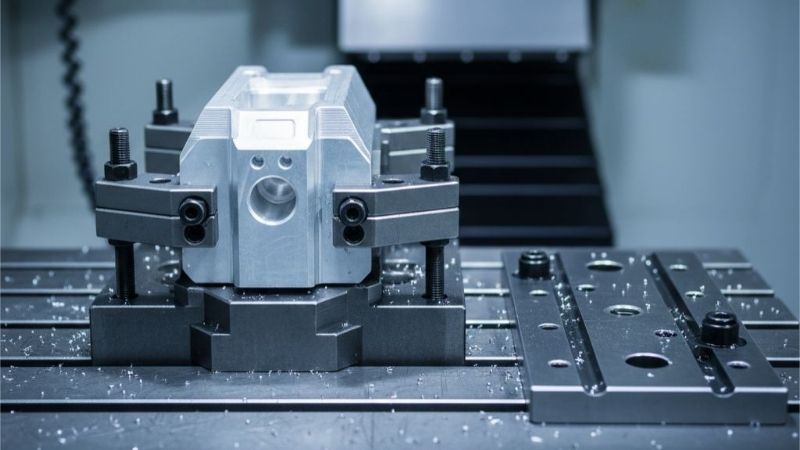
Here are 9 common types of jigs you might use:
Template Jig: A flat plate with holes in the right spots. Just place it on your part and drill, no need to mark anything.
Plate Jig: Like a template jig but with metal rings (bushings) to guide your drill. Some have feet to lift them off the surface.
Channel Jig: U-shaped like a tunnel. Slide your part in, and it stays in place. You can clamp it down on top.
Leaf (Hinged) Jig: Has a lid that swings open. Put your part inside, close the lid, and drill through the guide holes. Quick and easy.
Box Jig: Wraps around your part like a box, with holes on the sides for tools. It holds the part tightly and works from different angles.
Angle-Plate Jig: L-shaped or slanted. It holds your part at an angle so you can drill the side or a tilted surface.
Diameter Jig: Made for round parts. It holds them with V-blocks and helps you drill evenly around the circle. Some can spin the part.
Ring Jig: For ring-shaped parts. It clamps the ring and lets you drill around it. You can adjust and rotate it as needed.
Universal Jig: You can adjust this one to fit many different parts. It’s great when you work on different shapes often.
What are Fixtures?
A fixture is a tool that holds your part in place so the machine can work on it correctly. It doesn’t guide the tool; it just keeps the part still and in the same spot every time. This helps make sure all your parts come out the same.
Fixtures are often used in milling, turning, grinding, and other machining jobs. Some can also clamp the part once it’s positioned.
Types of Fixtures
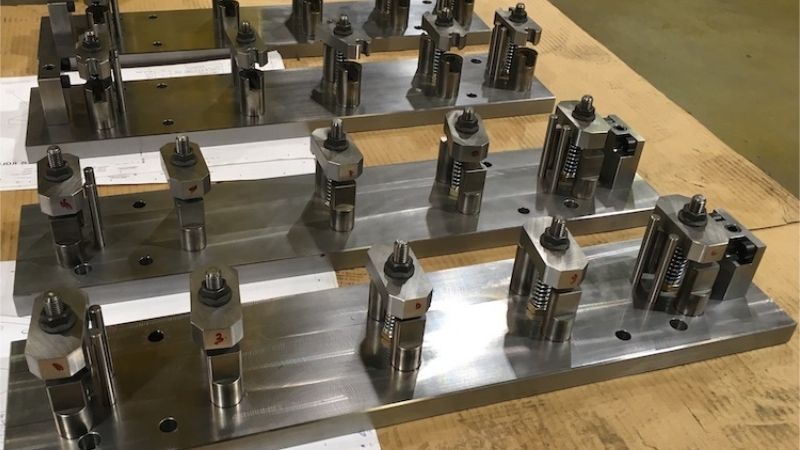
These are the 8 common types of fixtures:
General Workholding Fixtures: These include vises, chucks, and magnetic tables. They hold your part in place but don’t guide the tool.
Milling Fixtures: Used on milling machines. They have a flat base and stops to keep your part steady while cutting.
Turning Fixtures: For lathes, when the part isn’t round or can’t be held by a normal chuck. They help hold it at an angle or off-center.
Welding Fixtures: Hold your part still while you weld. They prevent movement and warping from heat.
Assembly Fixtures: Help you hold parts together while assembling with bolts, glue, rivets, or welding.
Indexing Fixtures: Let you turn the part to work on different sides without removing it.
Special Fixtures: Made for specific tasks like grinding, tapping, or boring. They hold the part just right for that job.
Tailstock Fixtures: Used on lathes or grinders to support the end of a long part so it doesn’t bend or shake.
Key Differences Between Jigs and Fixtures
Here’s an easy way to understand the difference between jigs and fixtures:
| Aspect | Jig | Fixture |
| Function | Guides the tool while you work | Holds the part in place while the machine works |
| Tool Control | Yes, it helps the tool follow the right path | No, it only holds the part steady |
| Workpiece Holding | Yes, but that’s not the main job | Yes, holding the part is its main job |
| Tool Contact | Yes, it often guides the tool directly | No, it never touches the tool |
| Typical Applications | Drilling, tapping, reaming | Milling, turning, grinding |
| Design | More complex because it needs tool guides | Simpler, mainly clamps and supports |
| Flexibility | Less flexible; usually made for one job | More flexible; can be used with many parts |
| Components | Drill bushing, locators, clamps | Clamps, screws, support plates |
| Weight | Light and easy to move | Heavy and built to stay in place |
| Setup Time | Takes longer to set up right | Faster to set up; just needs to hold the part |
| Cost | Usually costs more (special design) | Usually cheaper (simple design) |
| Use in Automation | Not often, since they’re very task-specific | Yes, often used in CNC and automated setups |
Advantages of Jigs and Fixtures
Here’s how jigs and fixtures can make your work faster, easier, and more accurate:
- You don’t have to measure or adjust each part again and again. Just set it once and go, so this saves a lot of time.
- Every part comes out the same. The jig or fixture keeps things in the right place, so you don’t make mistakes like drilling in the wrong spot.
- You don’t need a highly trained worker to get the job done. The jig or fixture helps guide the process, so anyone can follow it easily.
- You’ll mess up fewer parts. That means less scrap, less wasted material, and more usable pieces.
- Jigs help keep your hands away from sharp tools by guiding the drill or cutter along a set path. This lowers the chance of accidents.
- Some jigs and fixtures let you hold several parts at the same time. This is helpful when the machine takes a while to finish a cycle; you get more done with less waiting.
Disadvantages of Jigs and Fixtures
Even though jigs and fixtures help a lot, they also have some downsides you should know about:
- Most jigs and fixtures are made for just one part. Even small changes in the part’s design can make the tool useless.
- Big or multiple fixtures can take up a lot of room. You might also need special racks or lifting tools to move or store them.
- Over time, parts of the jig or fixture can wear out or go out of alignment. You’ll need to check, clean, and fix them often to keep things accurate.
- If the jig or fixture isn’t designed well, it can slow you down or cause mistakes. You need someone with the right skills to make it properly.
- It can take a while to install and line everything up just right. This setup time can be a problem if you switch parts often or work in small batches.
- Making a custom jig or fixture isn’t cheap. It only makes sense to spend the money if you plan to use it for a lot of parts over a long time.
Components for Jigs and Fixtures
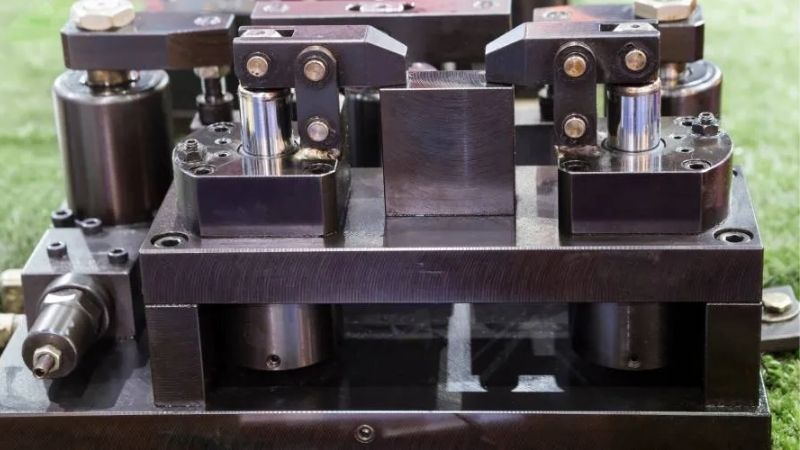
Even though jigs and fixtures are custom-made for specific jobs, most of them are built using the same basic parts. Here’s what you’ll usually find:
Base Body: This is the main support, like a flat plate or frame, that holds everything together.
Locating Elements: These help you place the part in the right spot. They can be pins, pads, V-blocks for round parts, or custom shapes.
Clamping Devices: Once the part is in place, clamps hold it still. Some use screws, knobs, cams, or even air pressure.
Tool Guides (Bushings): Only jigs have these. They guide your drill or tool so it hits the right spot.
Fasteners and Positioning: These are bolts and other parts that attach the jig or fixture to the machine and help you line it up.
Extra Supports & Safety Features: These include jack screws for weak spots, pads to protect the part, springs for easy removal, chip holes, and sometimes rulers to keep with alignment.
Mounting Systems for Jigs and Fixtures
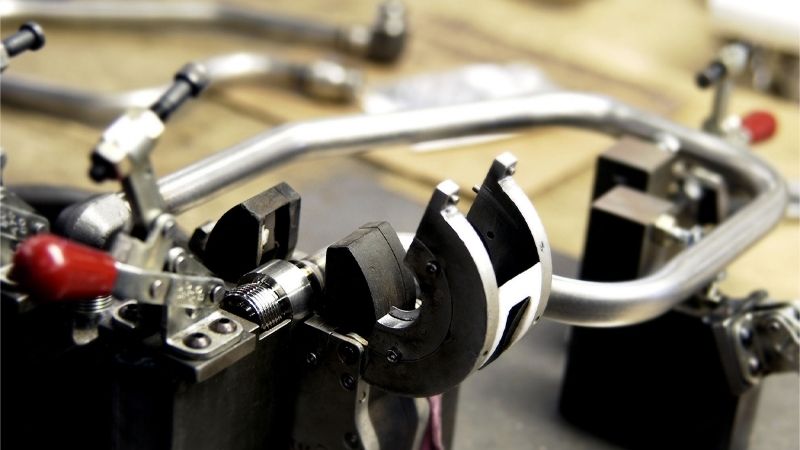
Before a jig or fixture can do its job, you need to mount it securely and line it up correctly on your machine. That’s where mounting and locating systems help.
T-Slot Tables and Nuts: Many machines have T-slots. You can use T-slot nuts and bolts to mount jigs or vises anywhere along the slot. It’s strong and flexible, but hard to place things in the exact same spot again.
Fixtures (Tooling) Plates: These plates have a grid of holes and dowel pin spots. They let you mount fixtures in the same place every time, great for quick setups or repeat work.
Locating Pins and Bushings: Use this for accurate positioning. Pins help place the fixture, and bushings guide it securely. They’re often used in quick-change systems.
Modular Systems: These come with a base plate, holes, clamps, pins, and blocks. You can mix and match parts to fit different jobs without making a new fixture each time.
Alignment Tools: For high accuracy, you can use dial indicators, edge finders, or reference balls to line things up by hand. Some setups use standard plates to make sure parts are always placed the same for inspection.
Designing Jigs and Fixtures
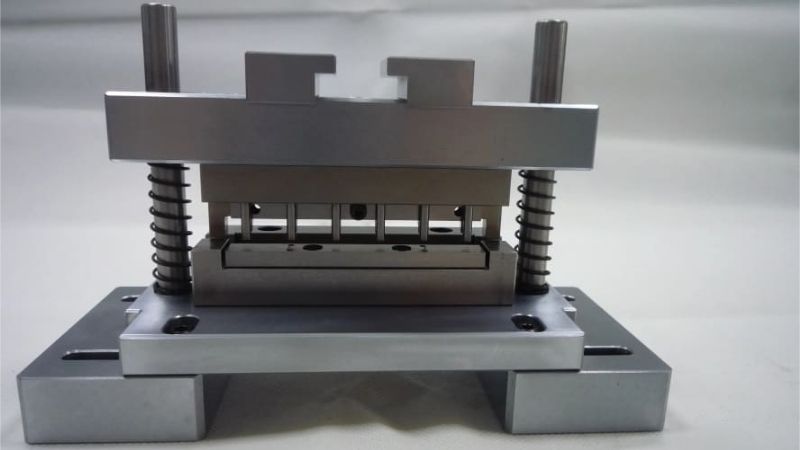
You can buy ready-made jigs and fixtures, but if you have special needs in your work, it’s often better to design your own. When you do, here are some important things to think about:
Orientation: Make sure there’s only one correct way to place the part in the jig or fixture. This helps avoid mistakes and keeps things simple.
Multi-uses: Design it to handle more than one task, like holding a part for both drilling and milling, so you can save time and energy. But don’t worry if that’s not always possible.
Material: Use strong and durable materials so your jig or fixture lasts a long time, especially if you’ll be using it often.
Handling: Design it so you can hold and move it easily, even with just one hand. This helps speed up your work and reduces strain.
Constraining: Your fixture needs to hold the part firmly, but don’t clamp it too tightly. If it’s over-constrained, it might bend or shift. Find the right balance between tight and flexible.
Force Analysis: Figure out how much force the jig or fixture will need to handle during use. Make sure it’s strong enough to take that pressure without breaking or moving.
Tolerances: Sometimes the part you’re working on isn’t perfectly shaped yet. Your jig or fixture should still be able to hold it properly, even if it’s a little off. A little flexibility in your design can help with this.
Applications of Jigs and Fixtures
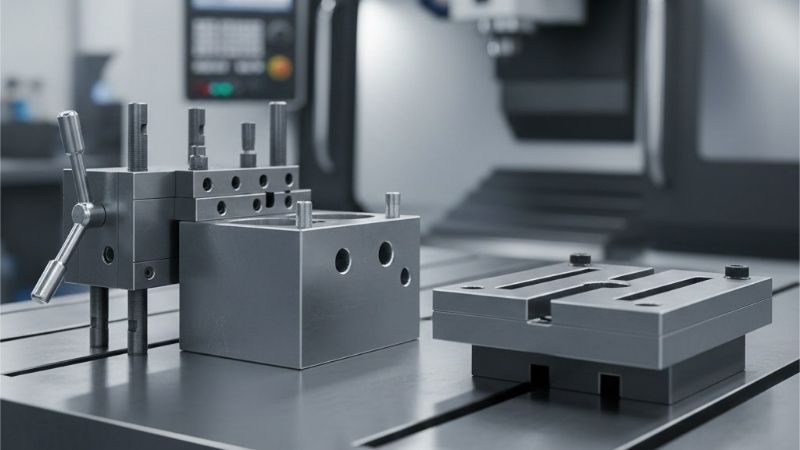
Here are some common uses of jigs and fixtures:
Metalworking and Machining
When you’re drilling, reaming, tapping, milling, or grinding, using a fixture helps you keep the part steady and get precise results.
Welding and Fabrication
If you’re welding or brazing, a welding jig helps you hold the metal pieces in the right position before joining them.
Assembly Work
When you’re putting parts together using screws, glue, or rivets, an assembly fixture holds everything in the correct position, like having a third hand to help you.
Inspection and Quality Checks
On a production line, you can use a checking fixture to see if a part fits correctly. You place the part in the fixture and use feeler gauges or visual checks to confirm it touches all the right spots. If it doesn’t, it’s out of tolerance.
Automotive Industry
Car manufacturers use jigs and fixtures all the way through the process, from making small parts to putting together the entire vehicle.
Aerospace Industry
When building airplanes, large jigs help keep big parts like the wings and body aligned during assembly.
Electronic Manufacturing
When making circuit boards, soldering jigs hold everything in place while the machine applies solder paste or heat, so the boards don’t move or warp.
Medical Device Manufacturing
Jigs help you drill holes or shape features on implants, like hip joints or bone plates, so they fit the body perfectly.
Conclusion
Jigs and fixtures make your work faster, easier, and more accurate. Jigs guide your tools, while fixtures hold your parts steady. You’ll use jigs more for hand tools and fixtures more with machines. Both are key when you need to make the same part over and over without mistakes.
At DEK, we offer 3D printing and CNC machining to help you create high-precision tools quickly and affordably. Contact us and get a free quote today. See how we can support your manufacturing needs.
