






Electric Discharge Machining (EDM): How It Works, Types, Materials, Tolerances and Costs

WRITTEN BY
Bing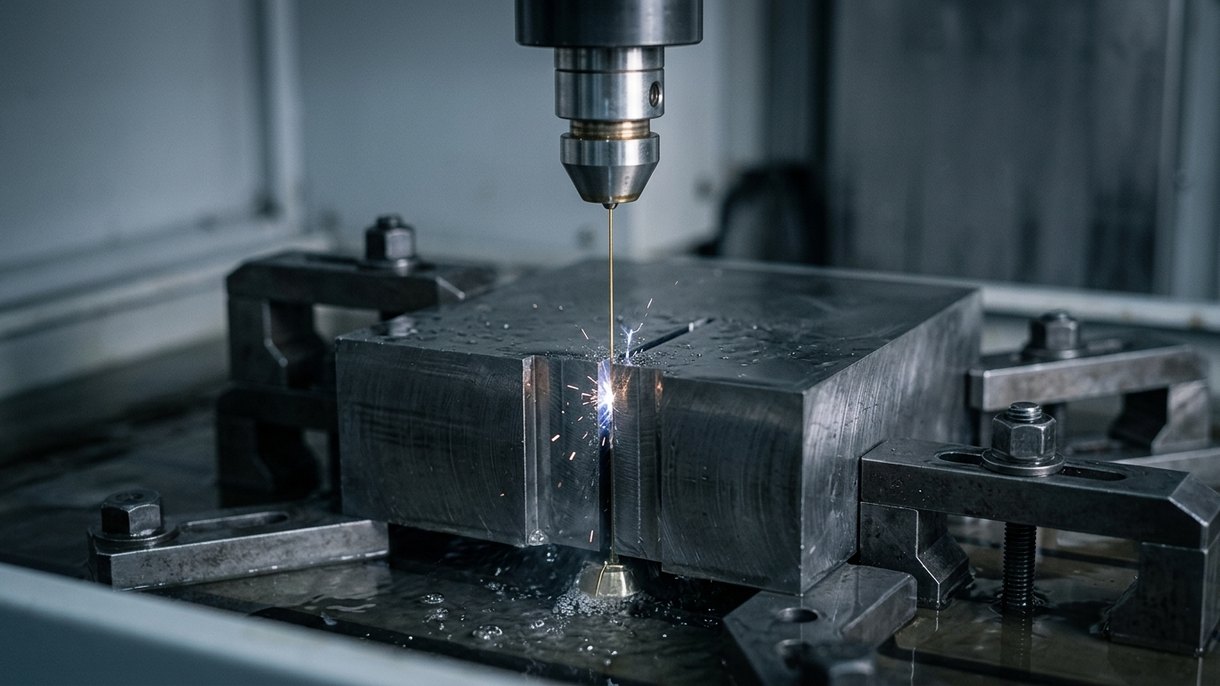
Electric discharge machining (EDM) is a non-contact process that removes metal with a rapid series of electrical sparks between an electrode and the workpiece, both submerged in a dielectric fluid. Because nothing touches the part and there is no cutting force, EDM cuts hardened steel, tungsten carbide, titanium and Inconel as readily as mild steel, holds tolerances of ±0.002–0.005 mm, and produces sharp internal corners and thin walls that a milling cutter cannot reach. This guide answers "what is EDM" in practical terms: physics, types, materials, tolerances, costs, applications and design rules.
What Is Electric Discharge Machining? Definition and History
Electric discharge machining, also written electrical discharge machining and often shortened to EDM or spark erosion, is a thermal machining process. A pulsed DC voltage is applied between a tool electrode and an electrically conductive workpiece separated by a small gap filled with dielectric fluid. When the voltage breaks down the dielectric, a spark jumps the gap, melts and vaporizes a tiny crater of material, and the fluid flushes the debris away. Repeated tens of thousands of times per second, this erodes the workpiece into the mirror image of the electrode, or along the path of a moving wire.
The practical process dates from 1943, when Soviet scientists Boris and Natalya Lazarenko, studying spark damage on tungsten contacts, realized the erosion could be controlled to machine hard metals. Sinker machines followed in the 1950s, numerically controlled wire EDM in the late 1960s, and by the 1980s CNC EDM was standard tool-room equipment. Today it is the process behind most stamping dies, mold cavities and carbide tooling, and a growing share of aerospace and medical parts.
How the EDM Process Works: Spark Erosion, Dielectric and No Contact
Every EDM setup has four elements: a tool electrode, a conductive workpiece, a dielectric fluid, and a pulse generator with a servo that controls the gap.
- Gap and charge. The servo holds the electrode 0.01–0.05 mm from the workpiece and the generator applies a pulse of 60–300 V.
- Breakdown and spark. Where the gap is smallest, the dielectric ionizes and a plasma channel forms at roughly 8,000–12,000 °C.
- Melting and vaporization. A microscopic crater of workpiece material melts and partly vaporizes; a much smaller crater forms on the electrode, which is why electrodes wear slowly.
- Collapse and flushing. The pulse ends, the plasma collapses, and the dielectric cools the molten material into debris that is flushed from the gap.
- Repeat. The cycle runs at 2,000 to 500,000 pulses per second while the servo advances the electrode to keep the gap constant.
Three properties of the EDM process follow from this physics:
- Hardness does not matter. A 62 HRC die block or a 90 HRA carbide insert erodes at a rate set by melting point and thermal conductivity, not strength.
- No mechanical force. Thin walls, delicate webs and pre-hardened components do not deflect, chatter or chip.
- Conductive materials only. Metals and carbides can be machined; glass, alumina, plastics and composites cannot.
The dielectric insulates until breakdown, flushes debris and cools the part. Wire EDM uses deionized water; sinker EDM uses hydrocarbon oil for better finish and lower electrode wear.
Wire EDM (Wire Electric Discharge Machining)
Wire electric discharge machining uses a continuously fed wire, usually brass or coated brass 0.1–0.3 mm in diameter, as the electrode. The wire runs from a supply spool through the workpiece to a take-up spool and is never re-used, so electrode wear does not affect accuracy. Guides move the wire along a programmed X-Y path, and independent U and V axes tilt it for tapers up to about 30° or for parts whose top and bottom profiles differ.
Wire EDM is a through-cutting process: the wire enters from an edge or a pre-drilled start hole and cuts a profile through the full thickness, from foil to 300 mm or more. A first pass roughs the profile; one to four skim passes at lower power remove the recast layer and bring the tolerance to ±0.002–0.005 mm at Ra 0.1–0.4 µm.
Typical wire EDM parts include punches and die plates, extrusion dies, hardened gears and splines, carbide form tools and medical instrument profiles. DEK's wire EDM services cover this range, and our guide to wire cut EDM goes deeper into wire types and cutting strategies.
Sinker EDM (Ram or Die-Sinking EDM)
Sinker EDM, also called ram EDM or die-sinking EDM, plunges a shaped electrode into the workpiece to reproduce its negative form. The electrode is machined first, in graphite or copper, to the cavity shape minus the spark gap. Under hydrocarbon dielectric the ram lowers it into the part, and the spark erodes a cavity that mirrors the electrode: a hexagonal blind hole, a textured mold cavity, a sharp-cornered keyway in a blind bore, or a fir-tree slot in a turbine disc.
Because sinker EDM needs no through path, it makes blind features, and because the electrode can be any 3D shape, it makes forms no rotating cutter can produce. A roughing electrode followed by finishing electrodes trades cycle time for finish. Accuracy is typically ±0.005–0.01 mm, limited by electrode manufacture and wear. Graphite is the most common electrode material because it machines easily and resists wear at high current; copper gives finer finishes on small, detailed electrodes.
Typical sinker EDM parts are mold cavities and cores, forging dies, blind hex and spline sockets and deep narrow ribs in mold inserts. See DEK's sinker EDM services and the ultimate guide to sinker EDM for electrode design and cavity finishing detail.
Small Hole EDM (Hole Drilling EDM)
Small hole EDM uses a rotating tubular electrode of brass or copper, 0.1–3 mm in diameter, with high-pressure dielectric pumped through the tube to flush the hole as it deepens. It drills holes at depth-to-diameter ratios of 100:1 and beyond in hardened or exotic materials: a 0.5 mm hole through 50 mm of Inconel takes minutes.
Its two main uses are start holes for wire EDM in hardened die plates, and functional holes such as turbine-blade cooling holes, fuel-injector orifices and spinneret holes. Position accuracy is around ±0.01–0.02 mm, and the walls carry a recast layer, so where finish matters the hole is often opened up with a wire pass afterward.
Sinker EDM vs Wire EDM vs Small Hole EDM
| Criteria | Wire EDM | Sinker EDM | Small hole EDM |
|---|---|---|---|
| Electrode | Brass or coated wire, 0.1–0.3 mm, continuously fed | Machined graphite or copper form | Rotating brass or copper tube, 0.1–3 mm |
| Dielectric | Deionized water | Hydrocarbon oil | Deionized water |
| Geometry | Through profiles, tapers, 4-axis ruled shapes | Blind cavities, 3D forms, sharp internal corners | Straight small holes, deep holes |
| Accuracy | ±0.002–0.005 mm | ±0.005–0.01 mm | ±0.01–0.02 mm position |
| Surface finish | Ra 0.1–0.4 µm after skim passes | Ra 0.2–0.8 µm, near-mirror with fine finishing | Ra 1.6–3.2 µm |
| Typical parts | Punches, dies, gears, carbide tools, medical profiles | Mold cavities, forging dies, blind hex and spline sockets | Start holes, turbine cooling holes, injector nozzles |
Materials for EDM Machining
Any material that conducts electricity can be EDM machined. In practice EDM is chosen for materials that are too hard, tough or heat-resistant to cut conventionally at reasonable speed.
| Material | Why EDM is used | Notes |
|---|---|---|
| Hardened tool steel (D2, H13, A2, M2, S7) | Cut at 55–65 HRC, so no distortion after heat treatment | The default material for wire-cut dies and punches |
| Tungsten carbide | Too hard to mill; grinding is slow for complex profiles | Low power and skim passes limit cobalt leaching and micro-cracks |
| Titanium | Work hardening makes milling difficult in thin sections | Remove recast layer on fatigue-critical parts |
| Inconel and other superalloys | Extremely tough; EDM cuts fir-tree slots and cooling holes with no tool wear | Slower removal rate than steel |
| Copper and brass | Thin, burr-free electrical contacts | Fast cutting, rougher finish at high power |
| Aluminum | Thin-wall and deep-rib features that would chatter under a cutter | Clean the oxide skin off the stock first |
Graphite is the most common sinker electrode material but is not a workpiece material at DEK. Non-conductive materials such as plastics, glass and alumina cannot be EDM machined at all.
EDM Tolerances and Surface Finish
EDM tolerances depend on the number of passes and the machine's thermal stability more than on the material.
| Pass strategy | Typical tolerance | Typical finish |
|---|---|---|
| Wire, single rough pass | ±0.02 mm | Ra 1.6–3.2 µm |
| Wire, rough + 1 skim | ±0.005–0.01 mm | Ra 0.6–0.8 µm |
| Wire, rough + 3–4 skims | ±0.002–0.005 mm | Ra 0.1–0.4 µm |
| Sinker, finishing electrode | ±0.005–0.01 mm | Ra 0.2–0.8 µm |
| Small hole EDM | ±0.01–0.02 mm | Ra 1.6–3.2 µm |
The recast layer. Every EDM surface carries a thin resolidified skin called the recast or white layer, 2–20 µm thick depending on pulse energy, over a heat-affected zone of similar depth. It is hard, brittle and may contain micro-cracks. On stamping dies it is harmless; on fatigue-critical parts such as turbine components, implants and springs it should be removed by skim passes, polishing, lapping or etching. A note reading "no recast layer permitted" means extra finishing passes, priced accordingly.
Corner accuracy. A 0.25 mm wire cannot cut a sharper internal corner than a radius of about 0.13–0.15 mm (wire radius plus spark gap). Smaller wires reach 0.05 mm radii at the cost of cutting speed. Sinker EDM produces corners as sharp as the electrode, which is why hexagonal and square blind holes are sinker work.
Advantages and Limitations of EDM
Advantages
- Cuts any conductive material regardless of hardness, including fully hardened steel and carbide.
- No cutting force, so thin walls, fragile webs and pre-hardened parts are machined without deflection or burrs.
- Sharp internal corners, deep narrow slots and blind complex cavities that cutters cannot reach.
- Tolerances of ±0.002–0.005 mm and finishes of Ra 0.1–0.4 µm without secondary grinding.
Limitations
- Conductive materials only.
- Slow material removal: typical wire cutting rates are 100–300 mm²/min in steel, so EDM is a feature process, not a roughing process.
- Recast layer and heat-affected zone need attention on fatigue-critical parts.
- Sinker EDM needs an electrode machined for each shape, adding cost and lead time at low volume.
- Wire EDM needs a through path, so blind features are out.
EDM vs Milling vs Laser vs Waterjet
| Criteria | EDM | CNC milling | Laser cutting | Waterjet |
|---|---|---|---|---|
| Materials | Conductive only, any hardness | Any machinable material; hardened steel and carbide are difficult | Sheet metals, some plastics | Almost anything, including stone, glass, composites |
| Thickness | Foil to 300+ mm (wire) | Limited by tool reach | Best under 25 mm | Up to 200 mm, accuracy drops with thickness |
| Accuracy | ±0.002–0.005 mm | ±0.005–0.01 mm | ±0.05–0.1 mm | ±0.1–0.2 mm |
| Surface finish | Ra 0.1–0.4 µm | Ra 0.8–1.6 µm | Ra 1.6–6.3 µm, dross possible | Ra 3.2–6.3 µm, striations |
| Heat effect | Thin recast layer (2–20 µm) | None | Heat-affected zone 0.1–0.5 mm | None |
| Best for | Hardened parts, sharp corners, thin walls, precision dies | General parts, pockets, 3D contours, high stock removal | Sheet-metal blanks and brackets | Thick plate, non-conductive or heat-sensitive materials |
In practice the processes combine: a die block is milled soft, hardened, then wire-cut and sinker-finished; a bracket is 5-axis milled, then slotted by wire EDM where the wall is too thin to cut.
EDM Cost Drivers and When EDM Is Cheaper
EDM machining is priced mostly by machine time. The drivers are:
- Cut length × thickness for wire EDM. Cutting rate in mm²/min is roughly constant for a given material, so a profile through 50 mm plate costs about twice as much as through 25 mm.
- Number of skim passes. Each pass adds 30–60% of the rough-cut time. Specify Ra 0.4 µm and ±0.003 mm only where needed.
- Start holes. Every closed internal profile needs a pre-drilled or EDM-drilled start hole.
- Electrode manufacture for sinker EDM: each cavity shape needs at least one electrode, often a rough and a finish electrode.
- Material. Carbide and Inconel cut 2–4 times slower than tool steel.
- Quantity. Wire EDM cuts a stack of thin plates in one pass, so unit cost for small profiles falls sharply with quantity.
EDM is cheaper than the alternatives when:
- The part is already hardened. Milling soft, hardening and grinding out the distortion costs more than wire-cutting the finished profile after heat treatment.
- The feature is a sharp internal corner, a narrow deep slot or a thin wall that a cutter would need multiple setups, tiny tools and slow feeds to reach.
- The material is carbide, Inconel or titanium in a geometry that consumes cutting tools faster than it produces parts.
- The quantity is one to a few hundred and the profile is complex: no fixture, no custom tooling, just program and cut.
EDM costs more for a soft aluminum or steel block with simple pockets and generous radii, or when large volumes of material must be removed. Rough by milling, finish by EDM. For pricing on milled work, see our CNC machining cost guide.
EDM Applications by Industry
- Mold and die. Injection mold cavities and cores, stamping and blanking dies, extrusion and forging dies.
- Aerospace. Fir-tree slots in turbine discs, cooling holes in blades and vanes, thin-wall Inconel and titanium components.
- Medical. Surgical instrument profiles in 17-4 PH and 440C, implant features in titanium, micro-slots in stainless tubing.
- Automotive. Fuel-injector nozzles, hardened transmission gear profiles, prototype gears and splines cut before hobbing tools exist.
- Electronics and semiconductor. Thin copper contacts, lead frames, carbide probe tips, precision slots in Kovar and Invar fixtures.
Design Tips for EDM Parts
- Set internal corner radii to the wire. Specify R0.15 mm or larger for 0.25 mm wire, R0.10 mm for 0.15 mm wire. A sharp internal corner on a through profile forces a sinker operation.
- Call out finish and recast requirements only where needed. Ra 0.4 µm and "no recast layer" on every surface can double machine time.
- Give the wire a way in. Plan a start-hole location for every closed profile, or let the profile open to an edge.
- State thickness and material condition. "D2, 60–62 HRC, 40 mm thick" lets the shop quote the exact cutting time; "D2" alone does not.
- Stress-relieve before cutting. Hardened blocks with residual stress move as the wire releases them; double tempering and a rough cut with a skin left on limit this.
- For sinker cavities, think about the electrode. Deep narrow ribs need thin electrodes that wear fast; add draft where possible and split deep cavities into inserts.
- Mark on the drawing which features are milled and which are EDM-cut so tolerances sit where each process can hold them.
Need EDM-Machined Parts?
Once the design is settled, the next step is a shop that runs wire, sinker and small hole EDM alongside milling, turning and grinding, so a hardened part is not passed between vendors. DEK's EDM machining services hold ±0.002–0.005 mm on wire-cut profiles and Ra 0.1–0.4 µm after skim passes, with no minimum order and an engineer reviewing every drawing before quoting, usually within 6 hours. EDM sits inside our wider CNC machining services, so a mold insert can be milled, hardened, wire-cut, sinker-finished and CMM-inspected under one purchase order.
FAQ
What is EDM machining used for?
EDM machining is used to cut hardened steel, carbide, titanium and superalloys into precise shapes that cutting tools cannot produce: stamping dies, mold cavities, gears and splines cut from hardened blanks, sharp-cornered blind sockets, deep narrow slots, thin walls and small deep holes. It is common in tooling, aerospace, medical and electronics manufacturing.
What is the difference between sinker EDM and wire EDM?
Wire EDM uses a thin moving wire to cut a through profile, like a very precise band saw, and reaches ±0.002–0.005 mm. Sinker EDM plunges a shaped graphite or copper electrode into the part to form blind cavities and 3D shapes with sharp corners, at about ±0.005–0.01 mm. Wire is chosen for profiles, sinker for cavities.
How accurate is EDM?
Wire EDM with skim passes holds ±0.002–0.005 mm on profiles with Ra 0.1–0.4 µm surface finish. Sinker EDM holds ±0.005–0.01 mm depending on electrode accuracy and wear. Small hole EDM positions holes to about ±0.01–0.02 mm. These figures assume a temperature-controlled shop and stress-relieved material.
Can EDM machine aluminum, titanium or plastic?
EDM machines any electrically conductive material, so aluminum, titanium, copper, stainless steel, tool steel, carbide and Inconel all work. Plastics, glass, alumina and other insulators cannot be EDM machined because no spark can form; those materials are milled, ground or laser cut instead.
Is EDM more expensive than CNC milling?
Per minute of machine time EDM is usually costlier, and it removes material more slowly, so simple soft parts are cheaper to mill. EDM becomes the cheaper route when the part is already hardened, needs sharp internal corners or thin walls, or is made of carbide or a superalloy that wears out cutters. Most tooling combines milling for bulk removal with EDM for the precision features.
WRITTEN BY
Bing manages daily production, covering scheduling, workflow coordination, and shop-floor control. He has strong experience in machining processes, tooling, and practical problem-solving. In his free time, he likes outdoor exploration and adventure trips.
Related Posts
-
 CNC Milling Copper : An Informative Guide
-
 What is Knurling : Definition, Process, Pattern and Tips
-
 CNC Machining Cast Iron : All You Need to Know
-
 6 Ways to Make Translucent and Transparent Parts
-
 Engineering Drawing: Importance, Basic Components & Tips
-
 CNC Turning Stainless Steel : The Ultimate Guide
-
 Waterproof Enclosure Design : Everything You Need to Know
-
 Metal Burrs: Formation, Types & Tips
-
 Swiss Machining Cost: Prices & What Affects Them

Ready to Scale Your Project?
Get started with a stable process and controlled quality. Let's discuss your project.