








FR4 Machining Services
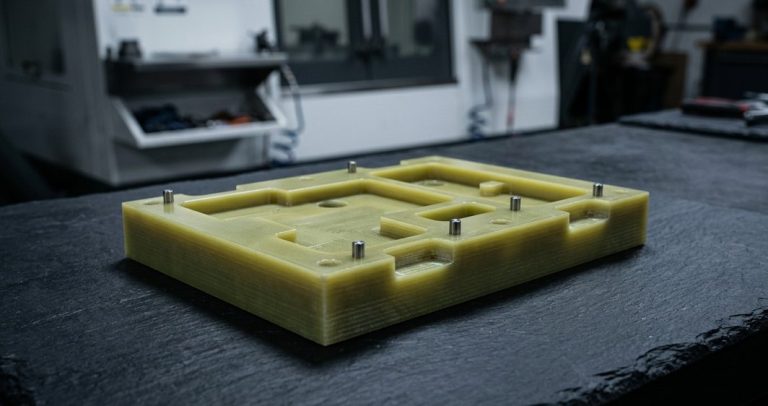
DEK's FR4 machining service produces test fixtures, probe plates, insulators and spacers from UL 94 V-0 glass-epoxy laminate to ±0.01 mm. Diamond tooling, backing plates and dust extraction prevent delamination.
-
±0.01 mm
Features Under 100 mm
-
3–5 days
Prototype Lead Time
-
UL 94 V-0
Flammability Rating

Why FR4 CNC Machining Suits Test Fixtures
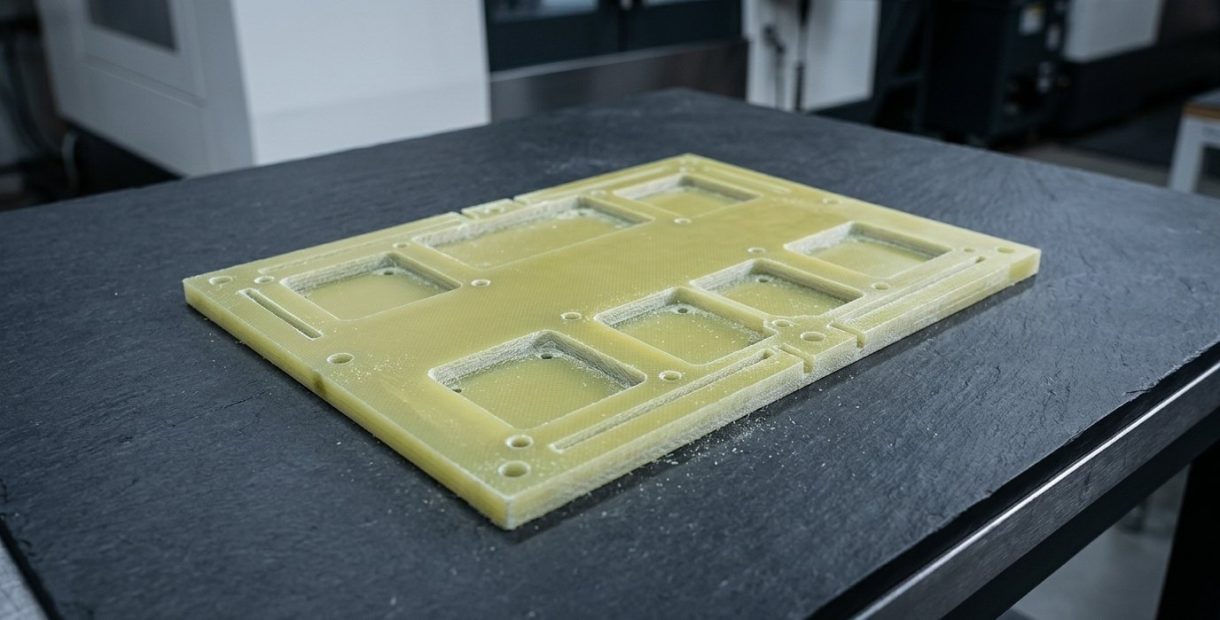
FR4 is the same flame-retardant glass-epoxy laminate as the printed circuit boards it sits next to, rated UL 94 V-0, with dielectric strength of 20 kV/mm and stiffness no unfilled plastic matches. It is one of the laminates in our plastic CNC machining services.
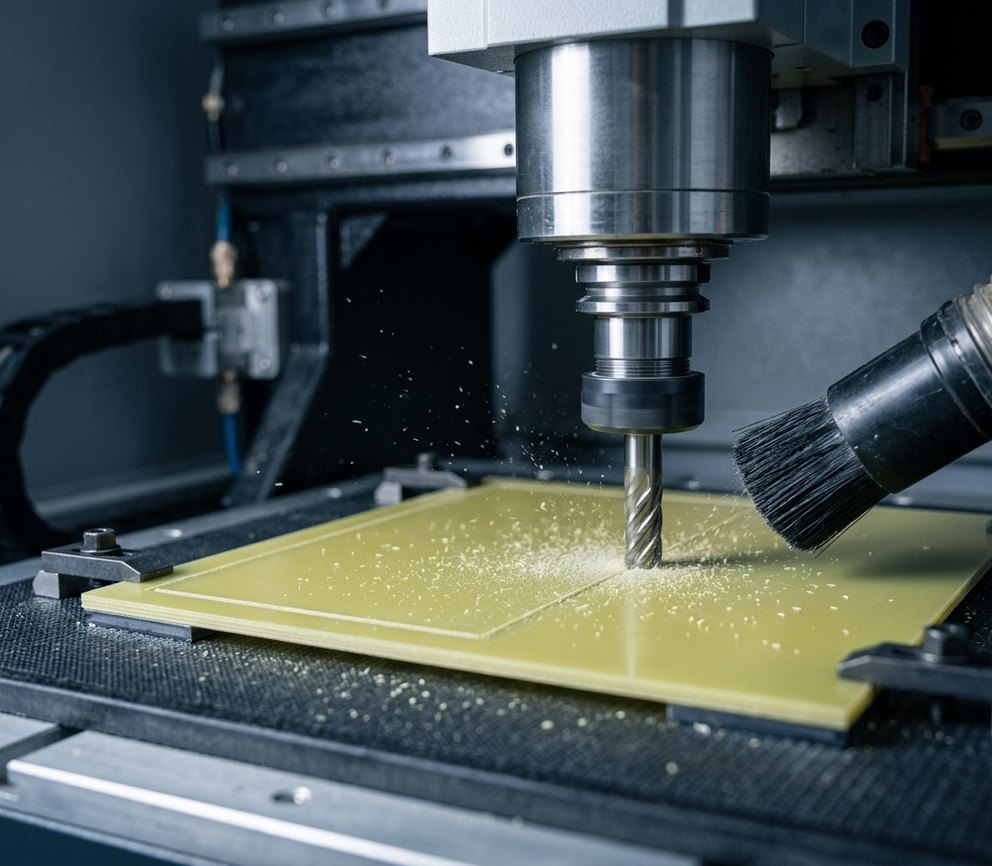
It is also abrasive, dusty and quick to delaminate under dull tooling. We machine it on the same 3-, 4- and 5-axis mills as your metal parts, with PCD and diamond tooling, sacrificial backing and vacuum extraction. Background is in our FR4 and G10 machining guide.
-

FR4 machining since 2002
-

ISO 9001:2015, ISO 13485 and AS9100D
-

Engineer-reviewed quote within 6 hours
-

Batches from 1 to 10,000+ pieces
FR4 Grades We Machine
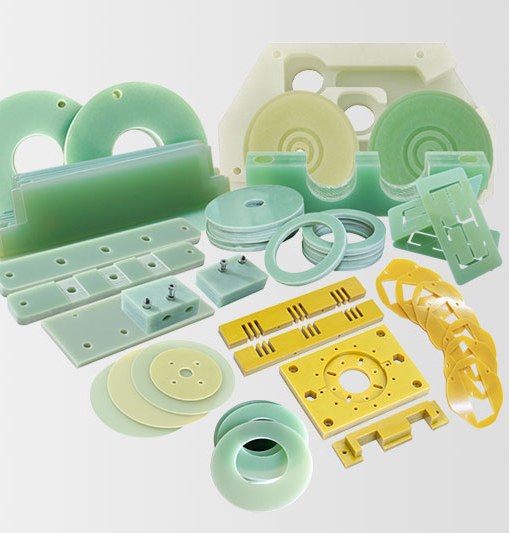
Glass-epoxy laminates chosen by flame rating and service temperature. Standard FR-4 runs to 130 °C continuous with 0.10% water absorption.
-

FR-4 NEMA grade
UL 94 V-0, 0.4–50 mm sheetThe standard natural yellow-green laminate for fixtures, insulators and spacers; 275–310 MPa tensile strength lengthwise and 1.85 g/cm³ density.
-

High-Tg FR-4
Tg 170–180 °CFor fixtures used in hot testing, reflow tooling and parts that sit near heat sources, where standard FR-4 at 130 °C continuous is not enough.
-

FR-5 / G-11
155–180 °C continuousHigher-temperature epoxy laminates for insulating parts that must keep stiffness above the service limit of standard FR-4 grades.
-
±0.01 mm
Features under 100 mm
-
±0.02 mm
Long plates and true position
-
Ra 1.6–3.2
As-machined finish, µm
FR4 Machining Capabilities at DEK
Milling, drilling, turning and profiling of laminate sheet, rod and tube, with in-plane expansion of 11–15 µm/m·K close to steel.
-
1
CNC Milling
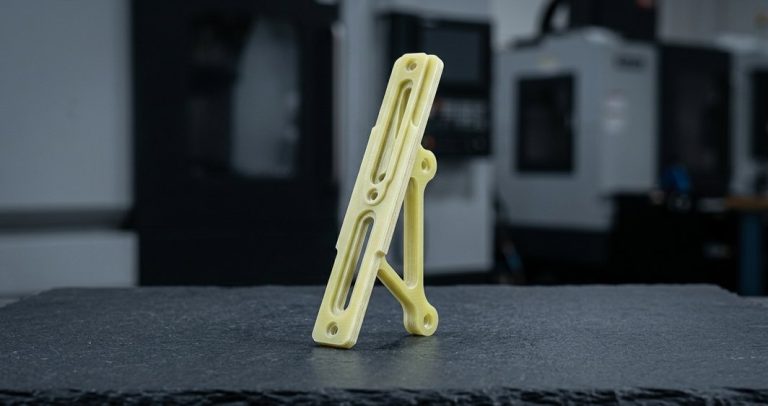
CNC milling on 3-, 4- and 5-axis machines for fixture plates, probe plates, insulator barriers, brackets and enclosure panels.
-
2
High-Density Drilling
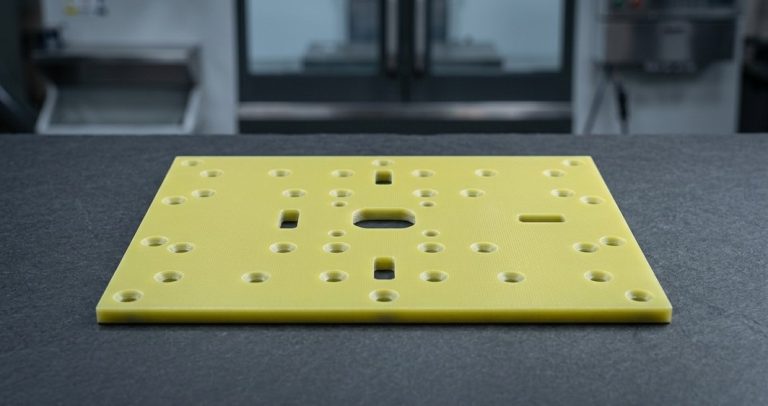
Probe and pin arrays drilled with PCD drills at 0.5–3 mm diameter, holding ±0.02 mm true position across 500 mm plates. See CNC drilling.
-
3
CNC Turning
CNC turning of rod and tube into standoffs, bushings, coil forms and insulating spacers for electrical assemblies.
-
4
Profiling & Slotting
FR4 sheet machining from 0.4 mm with compression routers, followed by edge sealing, ultrasonic cleaning and press-fit metal bushings and pins.
Design & Machining Tips for FR4
What our engineers check on every laminate drawing to avoid delamination, fraying and bowed plates.
-
1
Delamination Avoidance
Plies separate at hole exits and routed edges under dull tools or deep step-downs. We drill onto sacrificial backing, take light final passes and chamfer edges 0.3 mm.
-
2
Abrasive Tooling
FR4 wears carbide within a few parts. We use PCD and diamond-coated tools, track tool life per hole count and include tool consumption in the quote.
-
3
Dust Extraction
Glass and epoxy dust is a respiratory hazard and abrasive to machine ways; parts are cut with vacuum extraction or filtered flood coolant, then ultrasonically cleaned.
-
4
Flatness on Thin Plates
Cutting one face releases lay-up stress and bows thin fixture plates. We machine both faces evenly; flatness of 0.1 mm per 300 mm is realistic on 5 mm sheet.
-
5
Corners, Walls and Webs
Specify 0.5 mm internal radii and avoid features thinner than 1 mm. Keep 1.0 mm between adjacent probe holes, 1.5 mm on plates over 200 mm.
-
6
Threads and Inserts
Tapped FR4 threads hold light loads only. Specify press-fit metal inserts for cyclic loads and oversize clearance holes by 0.1 mm.
When to Choose FR4 vs G10, Ultem or Aluminum
FR4 is the default near electrical equipment or wherever a flame rating is specified; most test fixtures pair an FR4 probe plate with an aluminum frame.
| Criteria | This MaterialFR4 | G10 | Ultem (PEI) | Aluminum |
|---|---|---|---|---|
| Choose it for | Fixture plates | Cryogenic | Medical, sockets | Frames |
| Flame rating | UL 94 V-0 | None | UL 94 V-0 | – |
| Max temp | 130 °C | – | 170 °C | – |
| Tolerances | ±0.01 mm | Near-identical | Tighter | Tighter |
| Insulates | Yes | Yes | – | No |
| Cost | Lower | – | Far higher | – |
Where Machined FR4 Parts Are Used
From bed-of-nails probe plates to battery pack insulators, FR4 parts insulate, stay stiff and keep alignment with steel pins.
-
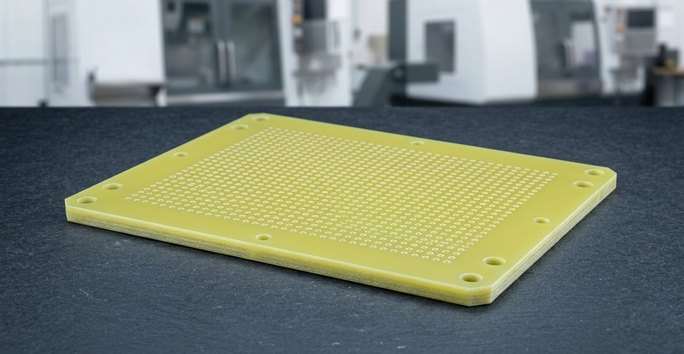 Electronics & TestIn-circuit and functional test fixtures, bed-of-nails probe plates, burn-in board carriers, reflow and wave-solder pallets.
-
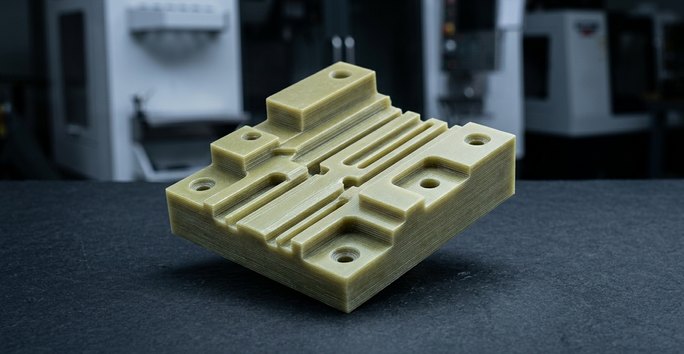 Electrical & SemiconductorBus bar supports, terminal barriers, transformer insulators, probe card stiffeners and handler nests for semiconductor equipment.
-
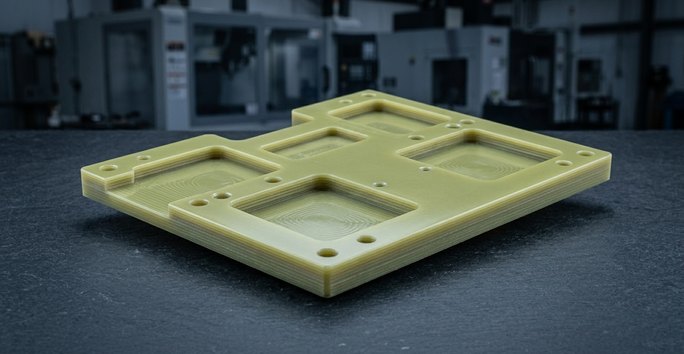 Industrial AutomationFixture bases, locating nests and insulating pads for assembly lines, built as jigs and fixtures.
-
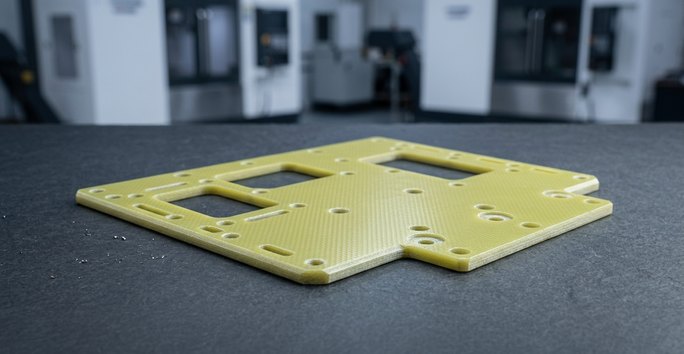 New EnergyBattery pack insulator plates and spacers, machined from UL 94 V-0 laminate sheet to ±0.01 mm.
-
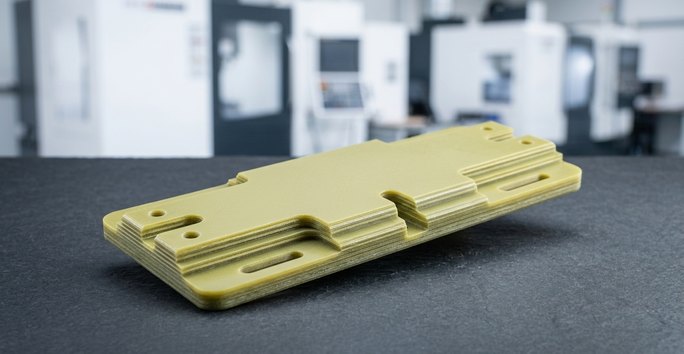 TelecomAntenna insulators that need a flame rating, stable dielectric strength and stiffness no unfilled plastic matches.
-
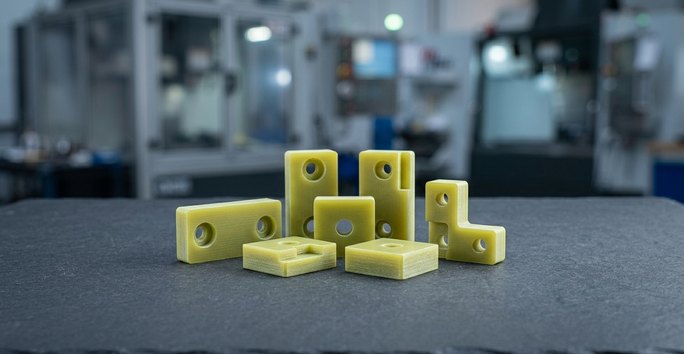 DefenseInsulators and spacers from flame-retardant laminate, inspected under AS9100D with IQC, IPQC, FAI and OQC.
Finishing Options for Machined FR4 Parts
CNC machining plus finish for FR4: anodizing, plating and vapor polishing do not apply to glass-epoxy laminate.
Need another finish or a flame rating? Ask our engineers.
-
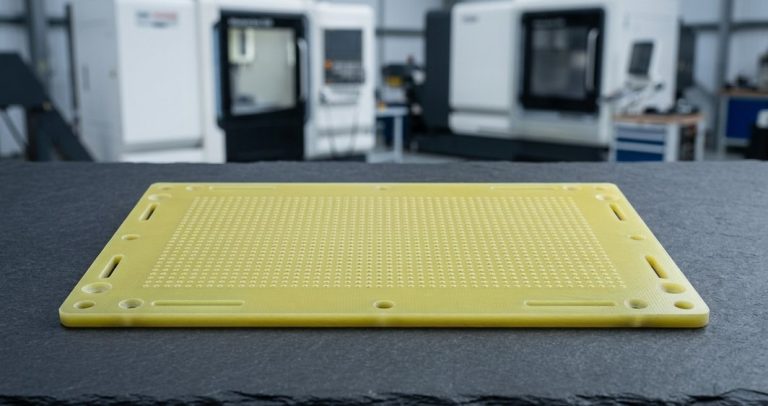 As-machinedStandardCNC machined with chamfered edges, the standard for fixtures and insulators; Ra 1.6–3.2 µm with light fiber texture.Get a Quote
-
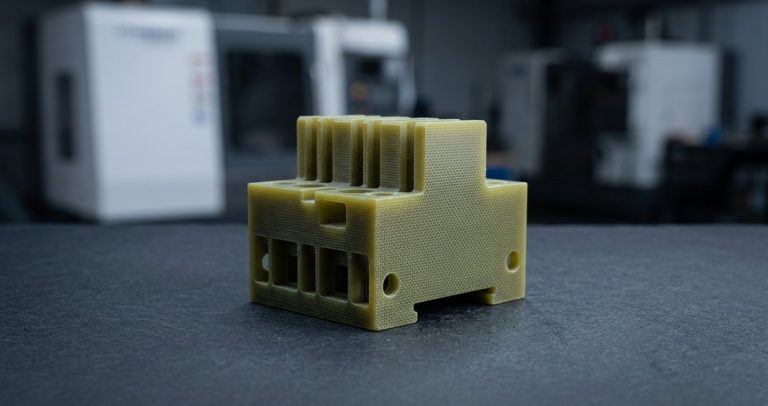 Bead blastingMost PopularCNC machining plus a matte blasted finish that evens out fiber texture on cosmetic barriers.Get a Quote
-
 Edge sealingMost PopularEpoxy or conformal coating over fiber ends after machining, for humid, vacuum or high-voltage service.Get a Quote
-
 PaintingMost PopularEpoxy and polyurethane coatings adhere after light abrasion; used for color coding on fixture plates.Get a Quote
-
 Laser marking & engravingMost PopularProbe numbers, part numbers and warning legends marked on machined FR4 plates and insulators.Get a Quote
FR4 Machining FAQs
Common questions about flame retardant laminate machining, delamination and tolerances.
Other Materials
-
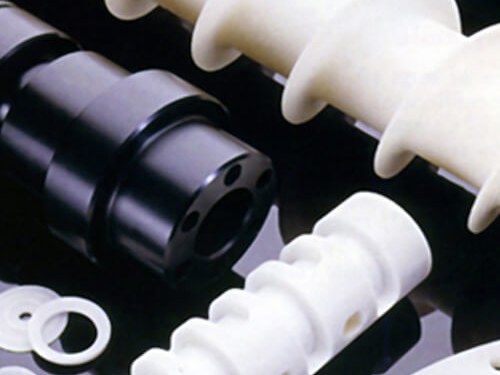 DelrinAcetal homopolymer (Delrin 150) and copolymer for gears, bushings, valve bodies and food-contact parts: clean chips, low moisture, ±0.01 mm typical.Learn More
-
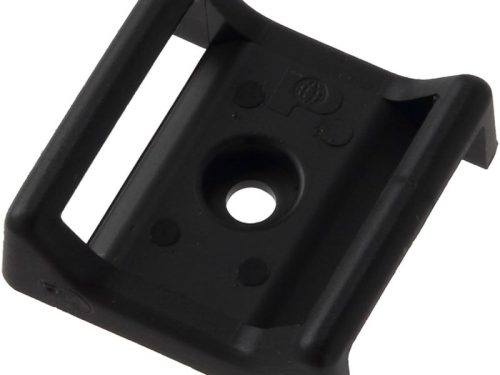 NylonTough, quiet, self-lubricating PA6, PA66, 30% glass-filled and MoS2 nylon for gears, bushings, wear pads, rollers and insulators.Learn More
-
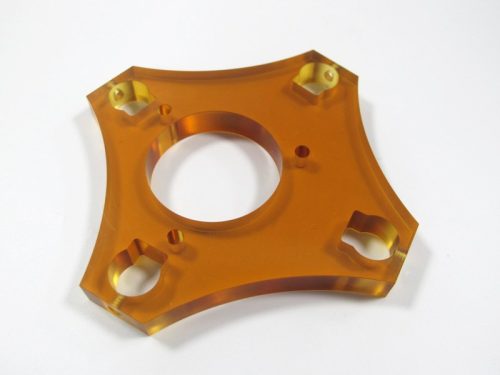 PEIUnfilled Ultem 1000 and 30% glass-filled Ultem 2300 PEI for test sockets, sterilization trays and aircraft brackets: 170 °C continuous, UL 94 V-0.Learn More
-
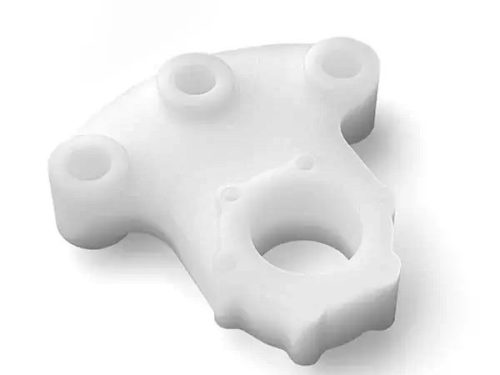 PolyethyleneUHMW-PE and HDPE: the lowest-friction, most abrasion-resistant commodity plastic, FDA compliant in natural grades, for wear strips and chain guides.Learn More

Ready to Scale Your Project?
Get started with a stable process and controlled quality. Let's discuss your project.