








What Is CNC Turning?
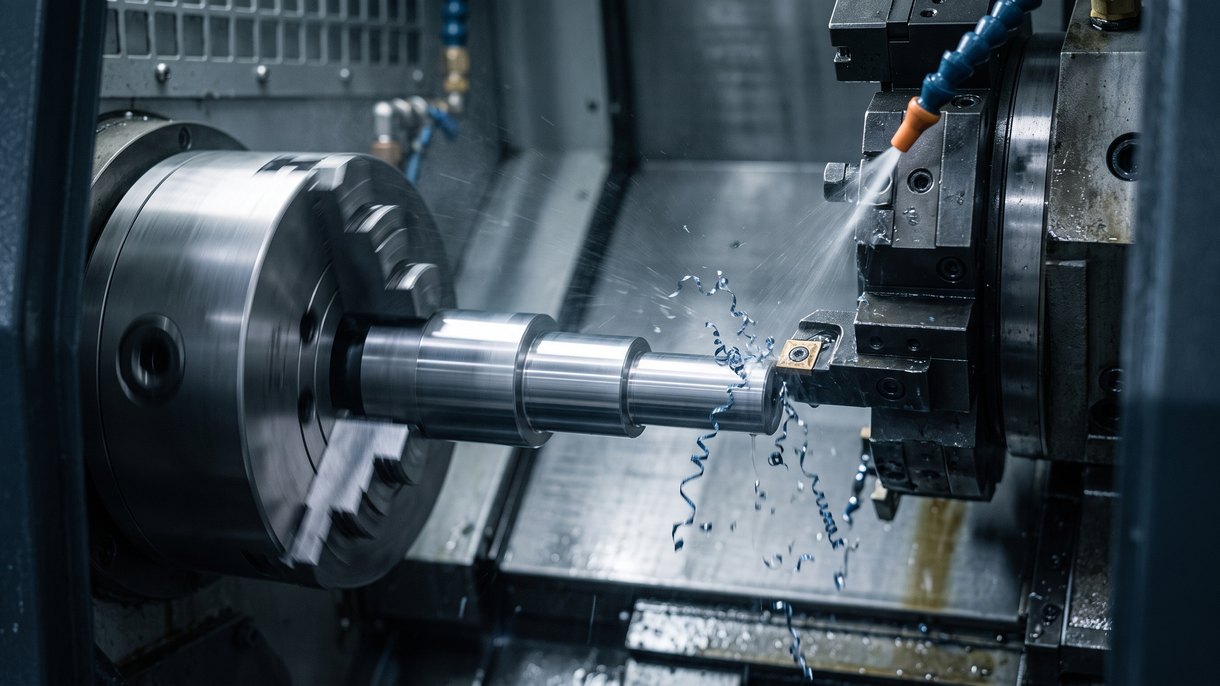
CNC turning is a subtractive machining process that removes material from a rotating workpiece to shape it into a cylindrical or otherwise rotationally symmetric part. A cutting tool (held stationary or fed along a controlled path) contacts the spinning stock and cuts away material until the finished profile is reached. The process runs on a CNC lathe or turning center, where a computer program controls the tool's position, speed, and feed rate instead of an operator turning cranks by hand.
Because the workpiece does the spinning rather than the tool, turning is the natural fit for round parts: shafts, pins, bushings, standoffs, and threaded fittings all start as bar stock chucked into a lathe.
How Does CNC Turning Work?
The workpiece is clamped in a chuck attached to the spindle of a lathe, which rotates it at a programmed speed. The cutting tool, mounted in a turret, moves along two main axes: Z (parallel to the spindle, controlling length) and X (perpendicular, controlling diameter), following the toolpath written into the CNC program. As the tool advances into the rotating stock, it removes material in thin layers until the part matches the programmed dimensions. Because the computer controls every move, the same toolpath repeats identically across a production run, with the operator's role limited to loading stock and checking the first parts off the machine.
CNC Turning vs. Milling vs. a Manual Lathe
A lathe is the machine; CNC turning is the automated process performed on it. On a manual lathe, an operator turns handwheels to move the cutting tool and set depth of cut: a skill-dependent process where part-to-part consistency depends on the operator. CNC turning replaces those handwheels with servo-driven axes controlled by a program, so the first part and the thousandth part come out the same.
The difference between turning and milling comes down to what moves. In turning, the workpiece rotates and the tool stays largely stationary, which suits round, cylindrical, or conical geometry. In milling, the tool rotates while the workpiece stays fixed or moves along limited axes, which suits flat faces, pockets, slots, and irregular shapes that aren't round. Many turning centers now add limited milling capability, letting a shop cut a flat or a cross-hole into an otherwise round part without a second setup; that split, round versus everything else, is the difference between CNC milling and CNC turning in practice.
Common CNC Turning Operations
A single turning setup can usually combine several of these operations without moving the part to a different machine:
- Facing: cutting a flat surface on the end of the rotating stock.
- Turning (OD turning): reducing the outside diameter along the length of the part.
- Threading: cutting helical grooves for screws, fittings, or fasteners.
- Grooving and parting: cutting narrow recesses, or cutting the finished part free from the remaining bar stock.
- Knurling: pressing a textured pattern into the surface for grip.
- Boring: enlarging or finishing an existing internal hole with a single-point tool.
Drilling is often performed on the same machine to open a hole before it's bored or threaded, though it's a distinct cutting operation in its own right.
Swiss Turning vs. Chucker Turning: Tolerances, Finish, and Size Limits
Two machine architectures cover most turned parts, and the choice comes down mainly to diameter and length-to-diameter (L:D) ratio.
Swiss turning feeds bar stock through a guide bushing positioned right next to the cutting tool, supporting the material along nearly its full length. That support lets Swiss lathes hold tight tolerances on small-diameter, long, slender parts with L:D ratios well beyond what an unsupported setup can hold without chatter or deflection. It's the standard choice for connector pins, small shafts, and other long, thin, high-precision components; Swiss CNC turning is built specifically around that guide-bushing setup.
Chucker (fixed-spindle) turning clamps the workpiece in a chuck with no guide bushing along its length. It handles larger-diameter stock, but unsupported length is limited relative to diameter; parts with a high L:D ratio become prone to deflection, chatter, and taper unless a tailstock or steady rest is added. Chucker setups are the default for shorter, larger-diameter parts: flanges, hubs, larger bushings, and housings.
If a part is small in diameter and long relative to that diameter, Swiss turning is usually the more accurate route. Short, larger-diameter parts are better suited to a chucker lathe.
| Spec | Typical Range |
|---|---|
| General CNC turning tolerance | ±0.02–0.05 mm typical; as tight as ±0.005 mm on DEK's general work |
| Micro-precision (sub-10 mm) parts | down to ±0.003 mm on DEK's Swiss turning |
| As-turned surface finish (Ra) | 0.8–3.2 μm; finer with a light finishing pass |
| Swiss-turned bar diameter | up to roughly 32 mm (1.25 in) |
| Chucker/fixed-spindle part diameter | up to roughly 1000 mm on DEK's large-part capability |
| L:D ratio, Swiss (guide-bushing supported) | up to roughly 20:1 |
| L:D ratio, chucker (unsupported) | typically 4:1–6:1 without a tailstock or steady rest |
Materials Machined by CNC Turning
CNC turning works across most metals and engineering plastics used in production parts. Common metals include aluminum, stainless steel, brass, and titanium, along with harder alloys such as Inconel, where tool selection and cutting speed need adjusting for the material's hardness. Machinable plastics (PEEK, PTFE, Delrin, and similar engineering-grade polymers) are also routinely turned when a part needs to be lightweight, chemically resistant, or non-conductive.

Limits of CNC Turning
Turning isn't the right process for every round-ish part, and it isn't free of its own failure modes:
- Thin walls flex under cutting force and chuck clamping pressure, which can leave a part out-of-round once it's released from the chuck. Thin-wall parts often need soft jaws or extra support rather than a standard three-jaw setup.
- Deep bores lose accuracy as the boring bar reaches farther into the hole and loses rigidity, leading to chatter and taper on the finished diameter. Very deep, small-diameter bores are better handled by deep-hole drilling, which uses long, supported tooling built for that reach.
- Setup cost on one-offs doesn't shrink with quantity; programming, tool selection, and fixturing take the same time whether you're cutting one part or a thousand. That overhead is why turning is most cost-effective once it's spread across a batch rather than a single prototype.
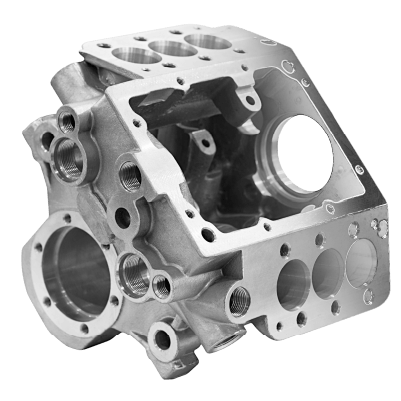
- Non-round geometry (flats, off-axis holes, or asymmetric pockets) needs milling operations added to the turning setup, or a separate milling step entirely.
If your part sits near one of these limits (thin walls, a deep bore, or a single prototype) send us the drawing and we'll confirm whether turning is the right process or whether another approach fits better.
Is CNC Turning Right for Your Part?
If a part is cylindrical or rotationally symmetric (a shaft, pin, bushing, standoff, or threaded fitting) CNC turning is typically the right process to start with. Parts that need flat faces, pockets, or off-axis features usually call for milling instead, or a mill-turn setup that combines both in one operation.
DEK runs precision CNC turning, including Swiss-type turning for smaller, tighter-tolerance components, with tolerances as tight as ±0.005 mm on general work and down to ±0.003 mm on sub-10 mm parts. Once you know the geometry and material, our precision CNC turning services can quote the part directly, and CNC turning cost factors sets expectations on price before you submit a drawing.
FAQ
What is CNC turning?
CNC turning is a machining process where a computer-controlled cutting tool removes material from a rotating workpiece to shape it into a cylindrical or rotationally symmetric part. It runs on a CNC lathe or turning center rather than a manually operated machine.
Is CNC turning hard?
Setting up the toolpath, tooling, and speeds/feeds takes real machining knowledge; that part is skilled work. Once the program is proven, though, the CNC automation runs the cut the same way every time, so producing consistent parts across a batch is far less demanding than doing it by hand.
Is CNC turning the same as a lathe?
No: a lathe is the machine, and turning is the process performed on it. A manual lathe requires an operator to move the cutting tool by hand; CNC turning automates that same cutting action using a computer program and servo-driven axes.
What are the downsides of CNC turning?
Turning is built around rotational geometry, so it's not the right choice for parts with flat faces, off-axis holes, or complex multi-sided features; those typically need milling or a mill-turn/5-axis setup. Thin walls, deep bores, and one-off setup cost are the other common limits to plan around.
Contact our team with your drawing, material, and tolerance requirements for a quote.

WRITTEN BY
Bing manages daily production, covering scheduling, workflow coordination, and shop-floor control. He has strong experience in machining processes, tooling, and practical problem-solving. In his free time, he likes outdoor exploration and adventure trips.
Related Posts
-
 Guide To Marine Propeller Shaft
-
 The Beginner Guide To Crankshaft And Camshaft
-
 Gear Shaving: Process and Principles
-
 Spotface vs Counterbore Holes: Key Differences
-
 Snap Fit Joints: Types & Benefits
-
 Spring Steel: Types and Uses
-
 Case Hardening: Benefits, Process, Types & Applications
-
 Custom Micro Screws: Complete Guide
-
 FR4 and G10 Machining: The Complete Guide

Ready to Scale Your Project?
Get started with a stable process and controlled quality. Let's discuss your project.