What is Carbonitriding: Types, Process, Applications
Carbonitriding is a thermochemical heat treatment process applied to improve surface hardness and strain durability of steel components. It combines the diffusion of carbon and nitrogen into the surface layer, making it ideal for high-performance industrial parts.
It gives controlled case hardening in manufacturing environments where wear resistance and dimensional stability are crucial. This step decreases distortion. It is also perfect for mass production and accurate components.
C'est quoi la carbonitruration ?
As a surface hardening method, carbonitriding involves heating steel in an atmosphere filled with carbon and nitrogen. Both elements diffuse into the surface and form a hard case, retaining a tough core. The processes are generally followed by quenching to obtain a martensitic transformation. It is conducted at a lower temperature than carburizing and produces a thin, hard case.
Types of Carbonitriding

Gas Carbonitriding
Gas carbonitriding is done in a controlled furnace atmosphere using hydrocarbons and ammonia as carbon and nitrogen sources. The process allows precise control of case depth, composition, and hardness.
The benefit of this method is that it can confirm uniform diffusion and consistent surface properties. Gas carbonitriding can be performed in both continuous and batch furnaces, which allows for high-volume manufacturing with consistent quality.
Salt Carbonitriding
Salt carbonitriding requires steel components in molten cyanide-based salt baths. Carbon and nitrogen quickly disperse into the surface. It produces a thin but extremely hard case within a shorter processing time.
Salt carbonitriding needs strict handling due to environmental and safety reasons. It is widely used for small parts where quick treatment and high surface hardness are needed.
The Carbonitriding Process
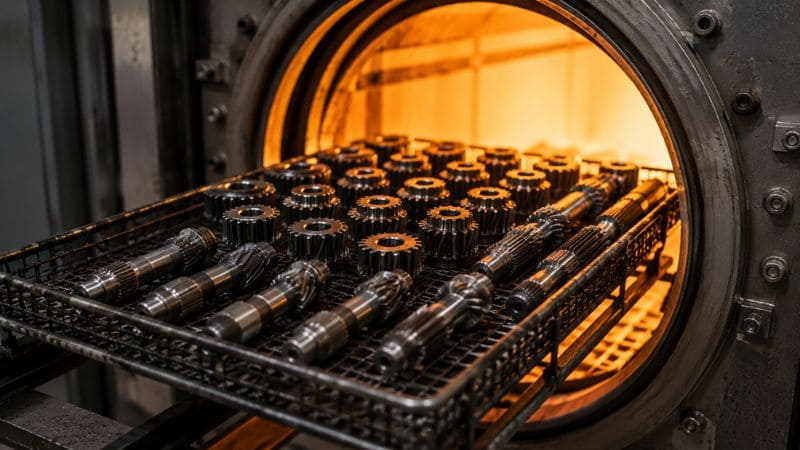
Carbonitruration is conducted at a temperature of normally 700°C to 900°C in a controlled atmosphere of carbon and nitrogen. During this stage, both elements diffuse into the surface layer.
After sufficient diffusion, quenching is carried out, usually in oil or gas, to generate hard martensitic case formation. Tempering may follow the quench to relieve stresses and improve toughness while maintaining surface hardness.
Advantages of Carbonitriding
- It improves surface hardness and wear resistance to put the components under conditions of heavy contact and sliding.
- The process improves fatigue strength by inducing compressive residual stresses on the surface. Therefore, it reduces crack initiation under cyclic loading conditions.
- Lower processing temperatures, relative to carburizing, limit grain growth, preserving core toughness and dimensional stability.
- It offers short cycle times for mass production, economically sustainable in the case of small and medium-sized components.
- Nitrogen presence contributes to improving hardenability, which permits effective case hardening even on low-carbon steels.
Disadvantages of Carbonitriding
- Carbonitriding creates shallow case depths, which limits its appropriateness for components needing deep hardened layers.
- Improper control of the process can lead to excessive retained austenite in the structure. It is an attendant penalty in terms of stability and hardness of dimension.
- There are environmental and safety concerns, particularly in salt-based processes, which need to be stringently regulated.
Appropriate Materials for Carbonitriding
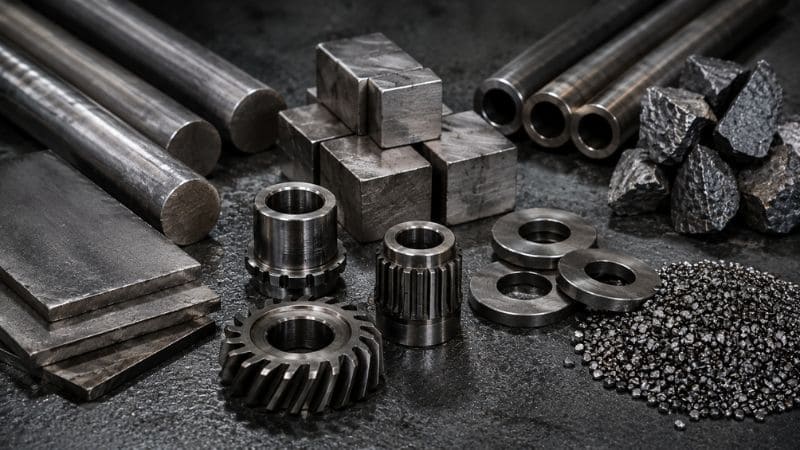
It is usually recommended for low-carbon and low-alloy steels. It can also be used on steel that contains up to 0.25 percent carbon. Usually, the effect is visible through the combined diffusion of carbon and nitrogen. In this case, the hardness is achieved by quenching.
The common steels used for this are mild steel and certain alloy grades intended for surface hardening. High-carbon steels are not usually selected as they are rendered brittle and can crack during treatment.
Carbonitriding Applications
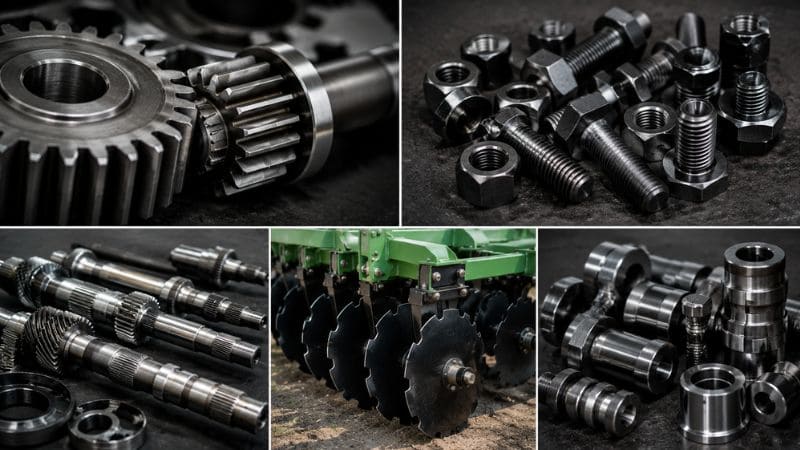
Gears and Pinions
Carbonitriding is commonly applied for gears and pinions that need great wear resistance and fatigue strength in confined designs.
Automotive Fasteners
Fasteners of the automotive kind benefit from carbonitriding in their surface durability and fretting resistance under load.
Shafts and Transmission Components
The hardening of the surface and retaining a tough core, shafts, and small transmission components apply carbonitriding.
Agricultural Machinery Parts
Carbonitrided parts are common in agricultural machinery, where repeated contact and abrasions are present.
Precision Industrial Components
Precision industrial components like cams and bushings utilize carbonitriding to ensure consistent surface performance.
Conclusion
Carbonitriding is the process in which carbon and nitrogen diffuse into the surface of components. It creates an effective surface hardening process that prevents components from wear, fatigue, and damage by various means. Controlled case depth and very low distortion during heat treatment make this process ideal for high-precision engineering.
If you are selecting the right heat treatment solution for your application, DEK provides expert guidance and advanced carbonitriding capabilities to ensure performance, reliability, and long-term component success. Message us maintenant.