
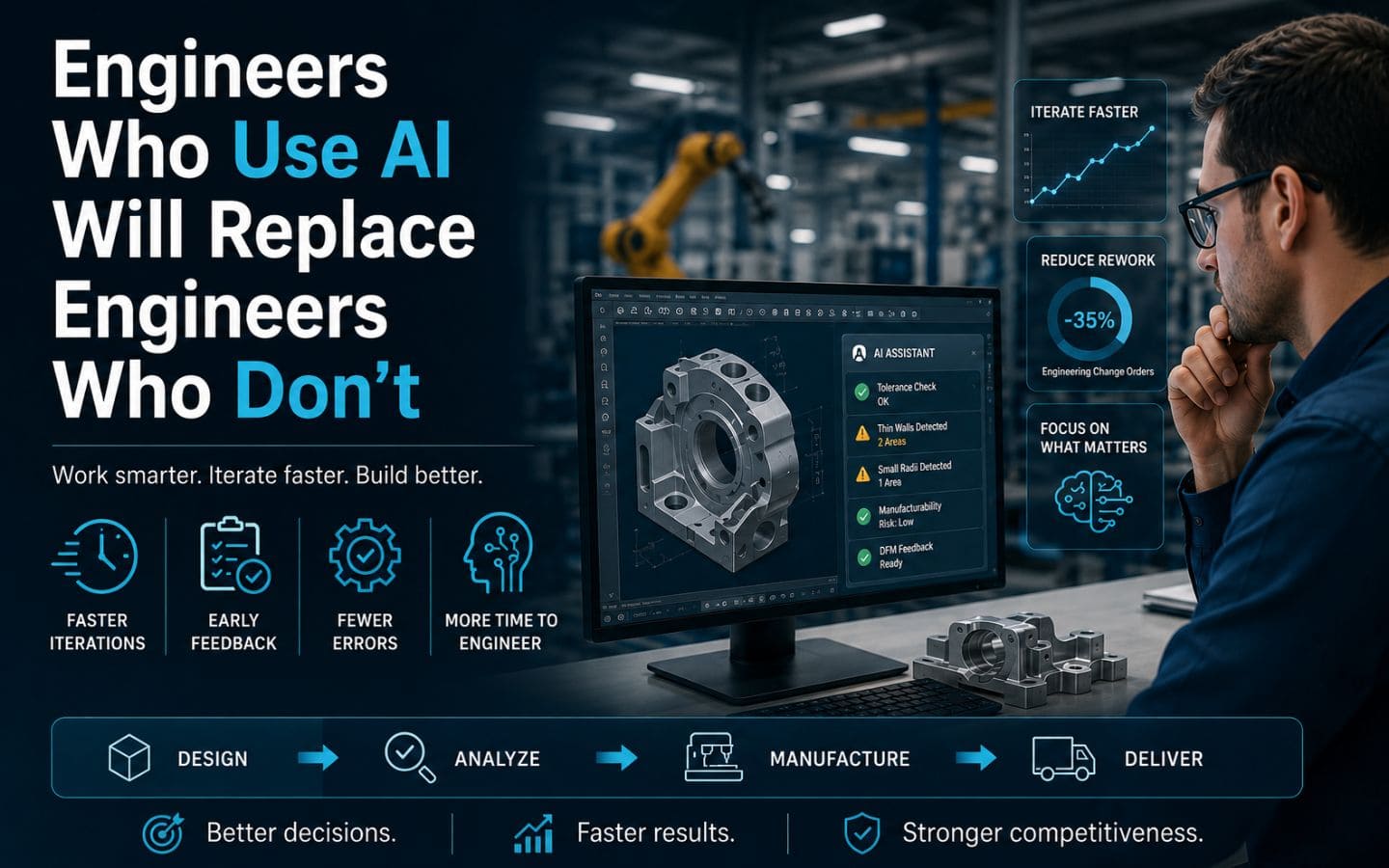
In the last few years, I have observed a quiet revolution in how engineering work gets done. It was not the result of a single day or a single invention. These are the types of changes anticipated as quoting expectations speed up, timelines tighten, and the pressure to get things right the first time increases.
We've noticed a consistent theme in conversations with customers and our own team. The engineers making the fastest progress aren’t necessarily the most experienced. They’re just working differently. They’re using AI to eliminate friction in their workflow.
I don’t think this is the death of engineering. But I do think it’s becoming a line. Not between good and bad engineers — but between those who adapt and those who don't. There's a well-known saying by Charles Darwin that "It is not the strongest of the species that survives, nor the most intelligent, but the one most responsive to change." This idea feels very real on the shop floor today.
How Engineering Work Has Quietly Changed
Engineering had very linear processes. Designing, checking, prototyping, and modifying were the key steps. Now, all these processes overlap.
There are fewer iterations, but they occur over shorter periods of time. A component that would normally go through three changes is suddenly going through six—all within the same time frame. This emphasizes the importance of making each and every change count.
Furthermore, there are increasing expectations for manufacturability. Components must be manufactured-ready at an earlier stage than before. There is less tolerance for designs that require several revisions after starting the manufacturing process.
Design for manufacturing feedback has also grown more efficient. Feedback, which used to take days, is now received within hours. Early matériel and manufacturing process selection is crucial.
What AI Actually Helps Engineers Do
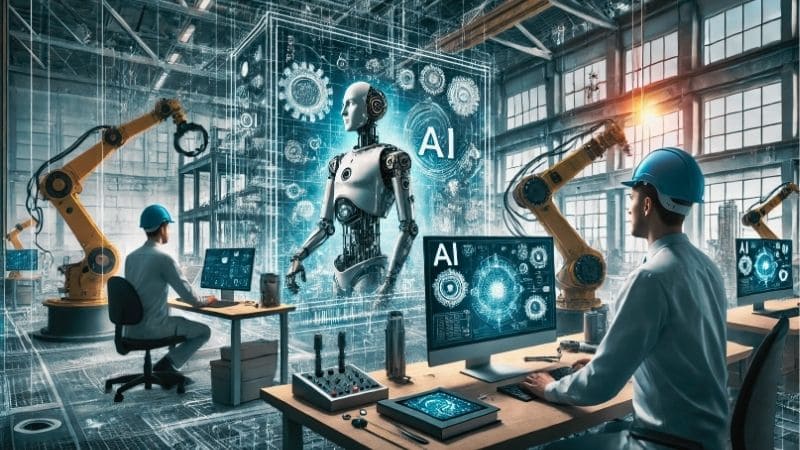
In considering the value of AI to engineers, I do not see a replacement of fundamental engineering thought processes. Rather, it strips out the repetitive layers surrounding them.
Engineers benefit from a more rapid review of drawings along with tolerance checks. Not necessarily a perfect one, but certainly quicker, allowing the detection of blatant errors prior to manufacturing.
Early manufacturability analysis is another area. Just receiving an alert for potentially problematic aspects of a design, such as thin wall sections or small internal radii, will save an entire iteration.
There are also the documentation capabilities. Version control, basic reporting functions, and repetitive calculations are things that can be done automatically. This leaves engineers more time to think.
What amazed me the most was the help it provides junior engineers. Things like recognizing risky areas of designs, which once took years of practice to do effectively, can now be assisted by AI. It doesn't replace senior judgment, but it can reduce the time taken to get up to speed.
Why Engineers Who Ignore AI Will Fall Behind
An engineer who does not use AI technology can produce quality results. However, their iterative process is not as fast as that of engineers using AI technologies. In the current environment, this means reduced opportunities for refining a design prior to production.
They also devote more time to such mundane tasks as drawing, formatting, and basic checks. This time could be used better to address genuine engineering issues.
A broader trend is also in place. Engineering has started to incorporate different disciplines. Mechanical solutions now relate to data, automated systems, and digital processes. Such developments are hard to keep up with without AI support.
How I’ve Seen AI Change Real Engineering Teams
The impact of artificial intelligence on our DEK engineering team and our partners' teams is tangible and practical.
More effort is spent on design, function, cost, and trade-offs, while less time is spent on details like drawing format or small errors.
The communication between the client and the manufacturing process has improved as a result of early alignment.
Furthermore, the usage of AI has reduced the amount of engineering change orders in cases where AI solutions were correctly implemented. Designs submitted are aligned with actual machining capability.
Junior engineers also benefit substantially from decision-making help, which allows them to develop their confidence earlier.
Misconceptions Engineers Often Have About AI
I am hearing similar arguments.
The first misconception is that AI will make them jobless. I cannot see this happening because AI lacks the understanding of the context like humans. Moreover, AI does not have any liability for the results.
Another belief is that AI cannot accommodate complicated components. On the contrary, AI does not necessarily have to comprehend the entire design in order to be relevant and helpful. Highlighting issues and errors alone saves time and money.
Engineers also think that AI increases their workload. This is because of the poor implementation of AI tools within the engineering process, which causes inefficiencies.
What Future-Ready Engineering Will Look Like
There will be a change in the engineer's role.
Whereas traditionally, engineers were responsible for performing every task themselves, future-ready engineering involves guiding systems that will execute some of the tasks automatically. The emphasis is on what the engineer intends to achieve through their design and manufacturing process.
Factors such as tolerance approach, process choice, and cost considerations will become increasingly critical. All these factors can be influenced by artificial intelligence, but are not decision-making criteria for AI.
There will also be more integration at various phases of the workflow. Designers, manufacturers, and partners such as DEK will work together in a single digital environment to reduce design and manufacturing inconsistencies.
At this moment, I'm reminded of B.F. Skinner once claimed about artificial intelligence. "The real problem is not whether machines think, but whether men do." Future-ready engineering does not remove the need for engineers to think. Instead, it raises the bar.
Conclusion
I don’t believe AI will completely replace engineers. But what I do think is that engineers who embrace AI will slowly edge out those who don’t.
It’s not that they’re necessarily smarter—it’s that they work with less friction. They move through iterations faster and spend more time thinking rather than wrestling with formatting.
In manufacturing, small advantages compound. Over time, the difference becomes hard to ignore.
