
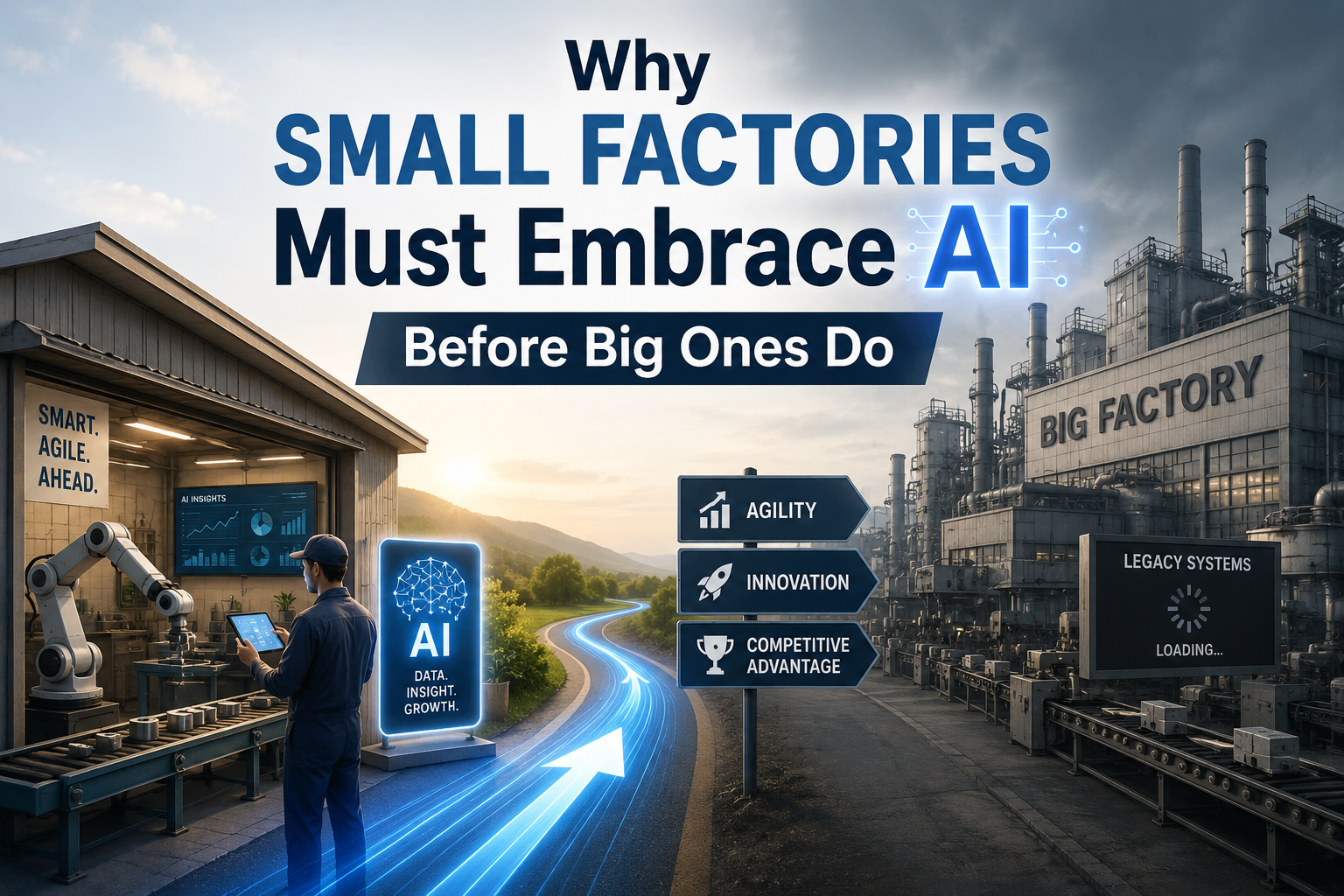
What is really on my mind these days is how the pressure is shifting on smaller factories. Customers want to be quoted faster, with tighter tolerances, more documentation, and shorter delivery windows every year. But the team size is the same. In many small shops, the machining team also handles engineering assistance, quoting, and quality control.
Most conversations about AI seem to focus on the big players in manufacturing; however, in my opinion, smaller manufacturing firms may, in fact, need AI more.
Why Small Factories Face Greater Pressure
In a small factory, there are not many buffers. If one skilled machinist is sick for a few days, the schedule will shift immediately. If an engineer gets overloaded, quoting will slow down. If inspection gets backed up, delivery is uncertain.
I witnessed this first-hand in a small medical parts shop. When one quality engineer took a week off, the entire workflow slowed dramatically, even though parts had been produced and machines were still running. The only issue was that the inspection reports were incomplete, which delayed deliveries. This was NOT a technical issue but rather a manpower issue.
Another complicating factor is that most leaders are active in daily operations. In many cases, they review prints in the morning, troubleshoot machining issues in the afternoon, and strategize with the customer on delivery in the evening. The pressure of that type of involvement does not scale as well as other companies.
As Peter Drucker once said, “Efficiency is doing things right; effectiveness is doing the right things.” The distinction between being effective and being efficient is increasingly important for small manufacturers.
Advantages Small Factories Have Over Big Ones
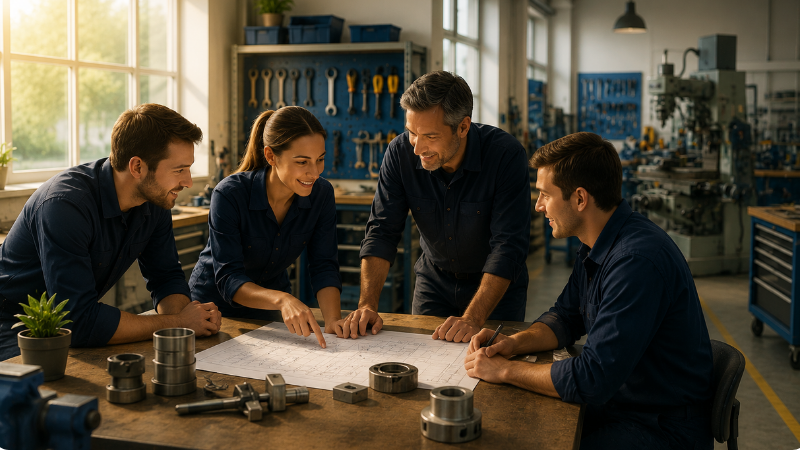
Many people fail to appreciate this fact. Small manufacturers have an advantage over large ones in making or changing decisions at maximum speed.
In smaller factories, it is possible for decisions to be made in one meeting, sometimes even in one conversation, right on the shop floor.
Because small teams can make changes to their workflow much faster than larger teams can, the benefits of a change that saves just one hour per day will be seen by all team members immediately. Although the difference in savings per person may appear minimal on paper, the overall impact of this type of improvement can be significant within a team of 10 or 20 people.
Where AI Delivers Immediate Value for Small Teams
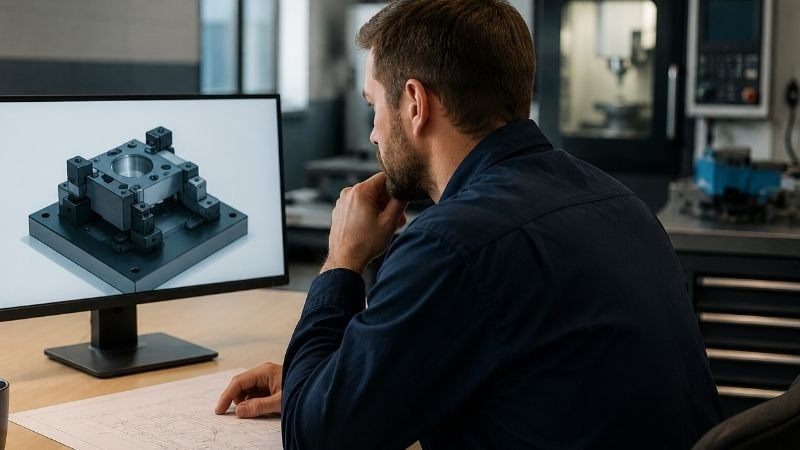
When AI is mentioned, one naturally thinks of complex automation. However, I believe that the greatest impact is felt in far more practical applications.
First, handle administrative tasks. Administrative chores, including generating bids, drawing analysis, creating production reports, and documenting processes, take up a large amount of time. Once these duties are completed more quickly, the time saved will be available to the engineer and machinists (who perform the tasks), allowing them to focus on their trade: addressing production difficulties.
AI enables smaller teams to enhance their processes earlier in the job, reducing the amount of rework required on a part after the fact. Even minor changes to initial setup planning and/or fixture decisions will result in hours of labor savings later on, which in a small facility can make a far bigger difference than most people realize.
Misconceptions That Hold Small Factories Back
The biggest obstacle isn’t technology. It’s perception.
For instance, some owners believe that only big companies with big budgets can use AI. Others believe that they must have perfect internal systems in place before they can begin to use AI. Others believe that AI is used to replace people rather than to make them better.
Henry Ford famously remarked, 'Whether you think you can, or you think you can’t — you’re right'. This is still very true today. Factories that believe in using AI to augment their workforce typically find ways to successfully implement AI into their processes. Factories that think AI is too complicated or too expensive for them to implement typically will not even begin to try to implement AI into their processes.
It's not about technological capabilities, but about whether leaders see it as a tool that supports people instead of replacing them.
How Early Adopters Are Getting Ahead
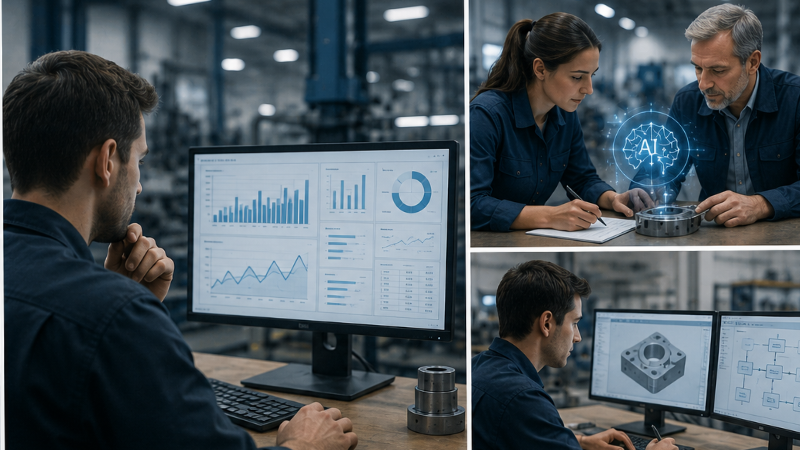
What I’m seeing now is that it’s not always the larger factories that are first to adopt AI. Instead, it’s often those who need more clarity in how their operations really work.
The first thing is often digital visibility. Not complex technology, but a better understanding of where time is really being wasted. Quoting delays, scheduling conflicts, drawing revisions, and inspection bottlenecks. Once those things become clear, decisions become much easier.
The next thing I’m seeing is how factories are using AI. Factories that are seeing success aren’t just using it to automate small tasks. Instead, they’re using it as part of better problem-solving. Their engineers are asking better questions about how to machine parts. Even less-experienced team members are thinking better about process planning.
I’m also seeing factories balance internal capabilities with flexible external resources when their workloads become less stable. This is not about outsourcing; it’s about protecting delivery reliability without putting additional stress on internal resources.
Lastly, I’m seeing AI improve quoting accuracy and delivery consistency simultaneously. While it’s not exciting to talk about outside, it’s significant within the factory because it reduces the daily stress.
What Happens If Small Factories Delay Adoption
One thing I've learned in the manufacturing industry is that the most significant hazards aren't always obvious. Instead, the most significant threats emerge gradually and then abruptly.
The first thing I notice about the delay in AI adoption in small factories is the competitive gap. The distance does not increase linearly. Instead, as the first manufacturer improves its quote speed, planning accuracy, and product delivery, the gap between it and the others widens dramatically. While it may not be obvious after the first year, the others will find it difficult to catch up by the second or third year.
The second effect I observe from the delay in AI deployment in small factories is a loss of human capital. Most small factories already operate with minimal labor. As the greatest machinists and engineers leave these facilities, it becomes more difficult to replace them year after year. The lack of instruments to assist less experienced personnel adds to the stress on those who remain.
The last step happens behind the scenes on the customer side. More and more companies are realizing that the choice of suppliers should not only be based on machining capability, but also on responsiveness, clarity of communication, and reliability of delivery. This is exactly the point at which data-driven factories start to differentiate. Once the customer gets used to this kind of reliability, there is no going back.
What concerns me the most is not the survival of the small factories. It’s that many of them will survive, but slowly lose their competitive edge simply because the industry has evolved, and the factories have not.
Conclusione
I don’t think AI will replace small factories. I think, in some ways, it will protect them.
But the ones that will benefit the most won’t be the biggest. They will be the ones who are the most flexible, the most pragmatic, and the most focused on making their teams better, not replacing them.
Because, in the world of manufacturing, growth has never been about getting more machines. It’s always been about making better use of the ones we already have.
