
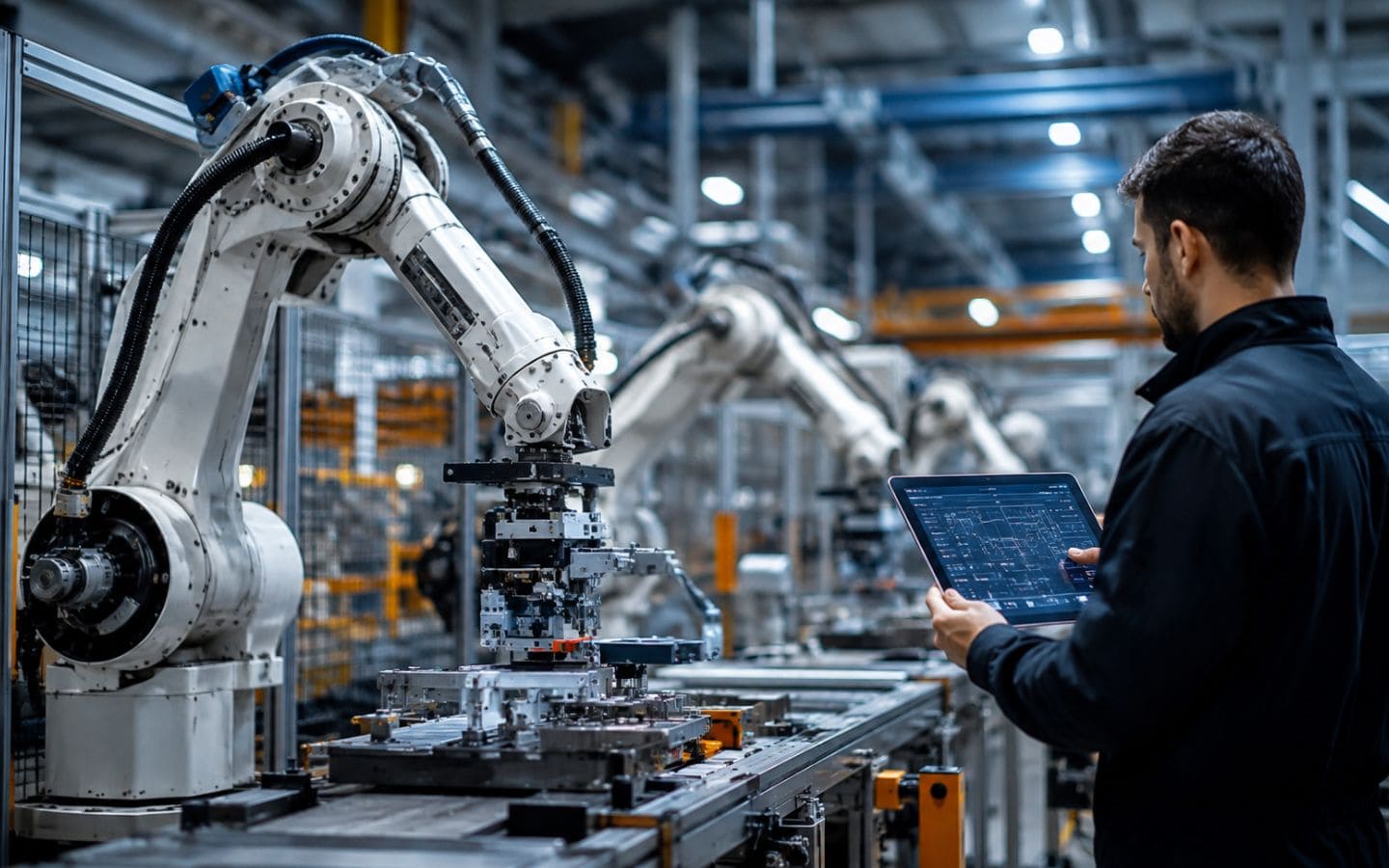
In the last ten years, what I have seen robotics do is move away from the structured environment of a lab and into an environment of real need in an industry context. This is not a technical problem but a structural one. No longer is the system evaluated solely on its ability to function in a demo. Now systems must be resilient to economic forces, variability in logistics, and an environment that will not allow for a lack of reliability.
Often ignored is the truth that systems do not fail when the concept is flawed, but when the system supporting the concept was not built for scalability.
The prototype should simply demonstrate feasibility. It's there to be answered: will it work?
However, the scalable product must demonstrate consistency in repetition, over time, and among operators who were not involved in the creation process.
This is where most robotics companies face difficulties: the gap between establishing that an idea is valid and the ability to produce the product in large quantities.
The Gap Between Prototype Success and Market Readiness
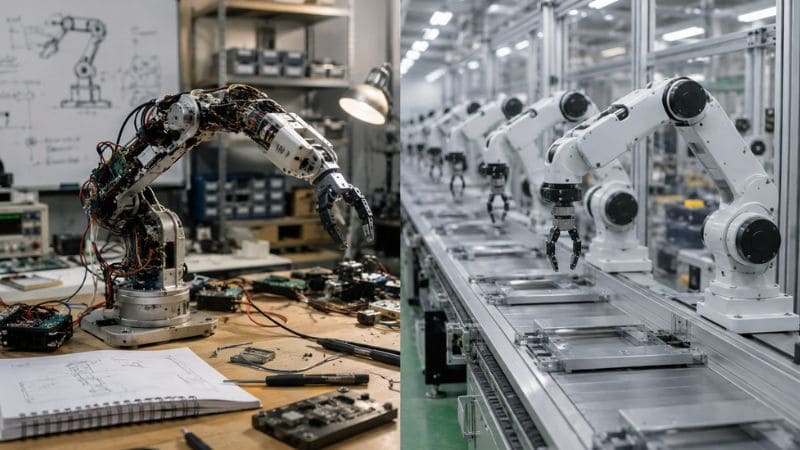
In early stages of robotic innovation, speed and flexibility reign supreme. Engineers work right up against the hardware, make decisions on the fly, and fix mistakes manually. In such an atmosphere, everything seems to be moving forward steadily.
However, prototypes often mask vulnerability.
Changes are introduced spontaneously without the use of formal procedures. Assembly becomes dependent upon a skilled person. Tolerances are known intuitively but not formally. It all works; only it doesn’t always work the same way without those initial engineers there.
When firms begin to move towards commercialization, however, this flexibility is a limitation.
That’s because when manufacturing starts, the variability stops being absorbed by engineering effort and becomes part of the product itself.
At that point, the critical issue isn’t whether the system works, but whether it works the same way each and every time.
The Operational Challenges That Block Mass Adoption
Scaling issues rarely manifest themselves immediately in any recognizable form. They take on forms of delays, discrepancies, and “edge cases,” which accumulate over time.
Inconsistency between the components of a device is the first limiting factor. In robots, even minor dimensional discrepancies affect performance significantly, especially in multi-axis systems where frictional forces, loads, and alignment play an important role. Components that comply with the tolerances may work in different ways anyway.
After that, sourcing becomes a limiting factor in its own right instead of just being a logistical one. A company that can easily supply a batch of ten prototype components will not be able to keep up the quality and consistency of a batch of a hundred pieces.
Test and validation loops become vulnerable as well. If one component, which is supposed to be machined, is missing, that would prevent system integration, thus holding back both hardware development and validation of software as well. At this stage, development of both mechanical and digital systems is not concurrent; it is sequential.
Internal misalignment tends to grow silently. Engineering seeks performance. Production seeks repeatability. Procurement seeks availability and stability. In the absence of common manufacturing standards, those needs will start to drift apart from each other.
Individually, none of the problems look critical. Collectively, they define success in scaling a product past early adopters.
What I’ve Seen From Fast-Growing Robotics Companies
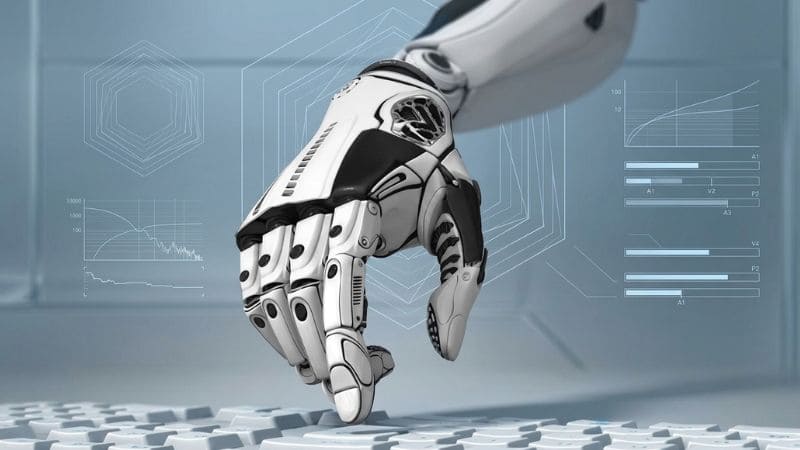
The one constant pattern that I have seen time and again is how tolerance analysis grows through necessity.
In early prototypes, variation is handled loosely. Engineers manually accommodate. Assembly is done by eye. The system works because there is a lot of care and very little quantity.
However, the system does not maintain manual accommodation. It brings it out.
With growing numbers of units, wear becomes evident from the assumptions. Diverse loads cause uneven wear of the bearings. Fasteners begin loosening due to the vibration cycles. Previously negligible angle variations start adding up to measurable drifts.
Finally, hardware variability starts limiting software development. The algorithms may be mathematically sound, but instability makes them ineffective.
There have been teams well-prepared for quick software iterations but constrained because of hardware variability.
At this point, the bottleneck is not about design anymore; it is system stability.
The first robots were built on the ability of engineering. The latter ones were built on manufacturing discipline.
It is normally at this point where companies stabilize their process or slow down due to complexity.
In the midst of these changes, certain groups have decided to hire manufacturing partners not because of capacity alone, but because of control. It’s not only about building pieces. It’s about minimizing variations so that engineering teams don’t have to keep compensating for physical variations while building.
This change from building to stabilization is what really marks the turning point of robotics.
Why Scaling Requires a Different Mindset Than Prototyping
Prototyping involves exploration. Scaling involves definition.
During the early stages, variation is fine since it drives learning. During the production phase, constraints are needed. The systems need to operate predictably without any interpretation or adjustment.
Rather than being concerned only with execution speed, scaling demands a change in the mindset of how decisions are measured. During the prototyping phase, a decision is assessed based on whether it works. During production, the assessment is based on whether it continues to work when repetition, fatigue, and variation become factors.
That’s when I always recall the words of Charles Eames, who once said, “The details are not the details. They make the design.”
In manufacturing, the words above are put into action. Tolerances define the alignment behaviors. Fixtures define the repeatability. Inspection methods define what "acceptable" really means in terms of production. Even the habits of the operators, such as staging of the parts, application of torque, and assembly verification, get translated into product behavior over time.
A minor issue in CAD becomes a persistent issue in production. This is how we distinguish experimental and scalable models.
When you start manufacturing, inefficiencies multiply.
Structure outperforms intuition in large-scale situations.
What Robotics Team Must Establish Before Growing
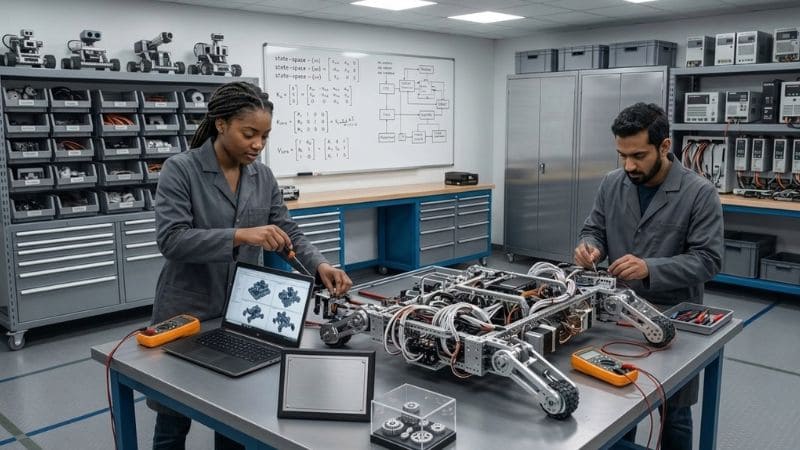
In fact, scaling companies usually start to think about operational effectiveness earlier than they believe they need to.
Production standards are the basis for such thinking. Without production standards, everything is considered “good enough.” In other words, subjective systems do not scale. Standards will set engineering intent and actual production processes.
Supplier alignment is also crucial. Precision manufacturing is not just about being able to do something but doing it consistently. Any supplier that does not meet consistent standards under load will add unexpected variability into your system.
Engineering-production communication needs to become constant and not sequential. Problems that appear in the manufacturing process need to influence decision-making on the design side, not just become isolated production problems.
Finally, the company needs to think about the lifecycle of its robotics. Revision and evolution in robotics take place during revisions and in the field, which makes designing for serviceability necessary.
All of these become secondary priorities during the prototyping stage. However, scaling always ends up bringing out the structural decisions from the temporary ones.
As the great systems thinker W Edwards Deming said: “A bad system will beat a good person every time.”
This happens all too often in the manufacturing industry. Competent engineers working in inconsistent systems just can’t produce consistent results. However, if the system itself is designed in an efficient manner (process, supplier, and inspection logic), performance is always guaranteed.
Quality is never made at the end of the production process. Quality is made by the structure that surrounds it.
Building a Scalable Model for the Coming Robotics Wave
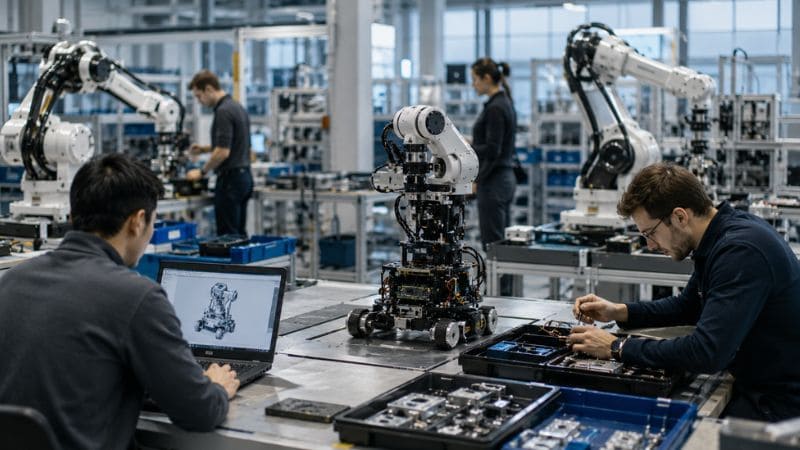
The next wave of robotics development won’t only be about technology innovations. It will be about integration of engineering, manufacturing, and logistics into one operating model.
These aspects can no longer develop separately from each other.
Engineering considerations need to take into account the realities of manufacturing from day one. Manufacturing input needs to rapidly inform engineering iterations. Supply chains should be an integral part of system architecture rather than separate infrastructure.
Hybrid models become a requirement. The internal team manages core system behaviors and intellectual property. Outsourced partners help in achieving stability, accuracy of capacity, and scalability of operations.
This separation enables businesses to scale up without losing grip on operational performance.
However, the structure itself isn’t enough. Discipline decides how robust the structure is.
With the increase of system scale, complexity grows faster than visibility. Without proper discipline, even minor misalignments build up gradually, leading to system limitations.
It is in such a process that many companies fail, not in the design, but in maintaining the coherence of design and execution.
Conclusione
Robotics is approaching an era where the key limiting factor is no longer one of capability. It is execution.
The winners of the coming decade will not be the firms with the most sophisticated prototypes. They will be the ones who can turn prototypes into replicable systems that endure at scale.
For the former is the proof of potential, while the latter is the proof of reality.
And the difference between the two defines the problem robotics CEOs need to address: how to make something work not once but always, even as everything else changes around it.
In manufacturing, scaling out does not validate concepts.
It validates systems.
