
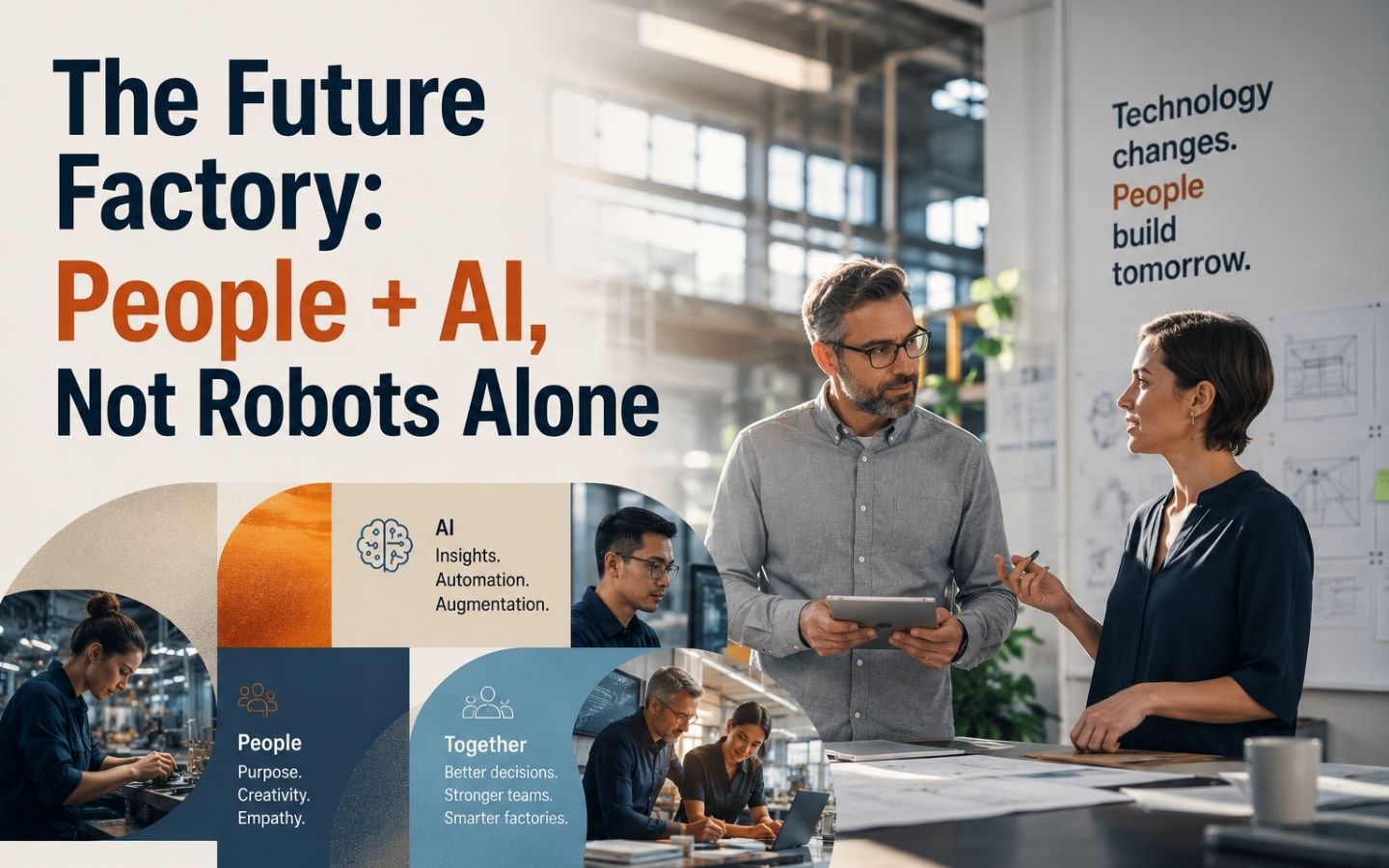
I've spent several years on the manufacturing floor, speaking with engineers, operators, and planners. One thing has been increasingly clear to me over the last year: the conversation has turned away from just automation.
For too long, the goal has been straightforward: reduce the number of humans, increase the number of machines, and finally improve efficiency. This method makes sense in manufacturing situations with predictable production and volume. Although robots and automation do well at repetitive activities, human insight is still essential to help make better decisions in a world that is becoming increasingly complex. AI allows us to combine human intellect with technology to build more intelligent decision-making processes.
Why Automation Alone Isn’t Enough
While the idea of fully automating your production is appealing, it’s much more expensive and time-consuming to deploy than many people realize.
When a process does not expect changes, automation works very effectively. But change in modern manufacturing is inevitable. Today it might be a complex production run of intricate parts, tomorrow it runs the next completely different operation with different tolerances and production timeframes.
I've seen many manufacturing companies spend enormous amounts of resources and energy implementing automation only to discover that their biggest challenges were not the physical tasks involved with automation, but rather the "soft" or "non-physical" tasks, such as knowing what to do if the automated system does not perform as expected or how to change the system if a customer suddenly requests that a production order be modified.
As stated by W. Edwards Deming, “It is not enough to do your best; you must know what to do and do your best.” Machines can perform tasks and produce results; however, many times when decisions are required based on mixed, complicated criteria, actions can still only be guided by individual understanding or interpretations.
The New Balance: Human Insight + AI Assistance

This is why I don’t believe AI is a replacement for people. I believe it is something that makes the people already inside the factory more robust.
The people operating the factory aren’t made obsolete. They are simply more aware of what is going on. The engineers don't lose their role either, but they become more important, as they can focus more on strategy and less on fine-tuning.
What AI does is allow people to spend less time reacting and more time thinking.
How AI Enhances Human Roles
AI has an impact on numerous functions, which vary based on the tasks of each team.
For example, programmers do not spend additional time polishing their CAM paths. Instead, they have more time to think about the big picture, such as manufacturing methods.
QC teams use AI to make the process more efficient and accurate, so they can focus on setting up thorough inspections and responding quickly to changes.
For planners, the advantage is also quite visible. They get more time because, with AI, they can even plan for bottlenecks in production and reschedule production accordingly. This results in optimal planning, avoiding unexpected situations, etc.
People who work directly with customers, they are given more freedom because this information is provided to them in a very short time and with more certainty.
Operational Changes in the Future Factory
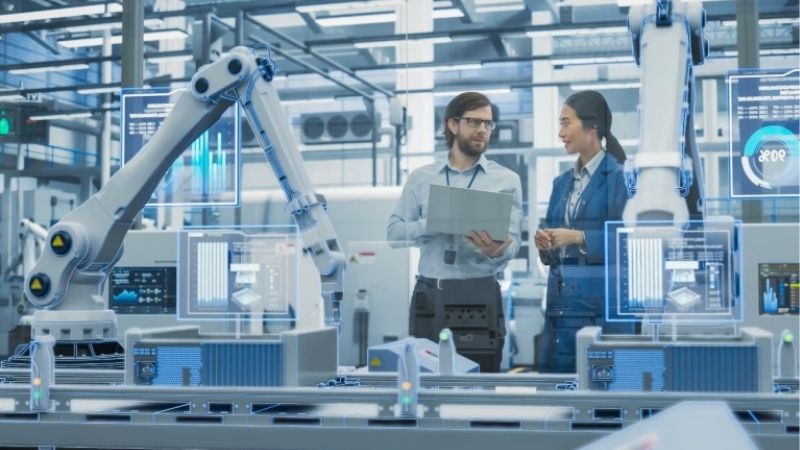
The changes taking place now will affect not only technology but also how a factory runs as a whole. For example, rather than operating in a linear process in which each stage waits until the preceding one is complete before progressing, the factory will operate in the future as a single, fully connected system.
As a result, how designs are produced will affect machining earlier in the process. Furthermore, engineers will obtain high-quality feedback from machining much more quickly, enabling considerably more flexible planning through faster information transmission.
The Skills the Workforce Will Need
I don’t believe that the future workforce will necessarily have to become more robotic. I think it will have to become more analytical.
The operators of the future will not only have to know how to operate machines; they will have to know why something works or doesn’t work. Engineers will have to think beyond just design; they will have to think about manufacturability sooner. Planners will have to think quicker than ever before, as they will have more information than ever before in real-time.
AI does not replace human thinking; it makes it more valuable.
How Leaders Can Build a People + AI Culture
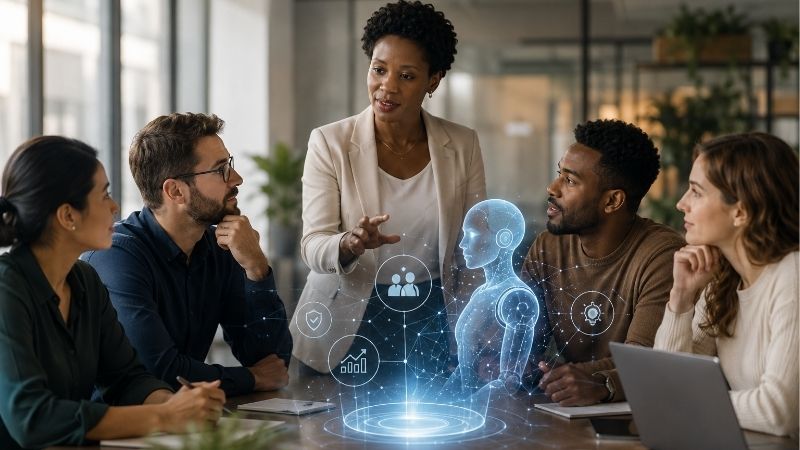
One thing I’ve learned over the years is that technology alone never changes a company. Culture does.
If people see AI as something that replaces them, it will create resistance. But if they see it as something that helps them work smarter, the reaction is completely different. The companies that benefit the most from AI will not be the ones with the most advanced tools. They will be the ones who help their teams adapt to those tools.
Leaders can start by encouraging a mindset of experimentation and viewing mistakes as opportunities to learn and develop.
Peter Drucker famously stated, "Culture eats strategy for breakfast." Regardless of how advanced your AI tools are or how efficiently your team members function, a positive culture enables people and technology to work together.
My Perspective
I don’t believe the future factory will be defined by how many robots it has. It will be defined by how well people and technology work together.
Automation will still matter. AI will definitely matter. But the real advantage will come from companies that know how to combine human experience with machine intelligence instead of trying to replace one with the other.
That’s where I think the industry is heading, not toward factories without people, but toward factories where people make better decisions because of the tools they use.
