
Stellite Welding in Machining: Benefits, Process, Methods
Stellite welding is the process of improving the strength, wear resistance, and heat durability of tools under extreme conditions. As far as milling, turning, or CNC operations are concerned. The right hard-facing solution would enhance tool life performance and service considerably.
Much of machining applications continue to use stellite overlays made under continuous friction, under elevated temperature, or under loaded pressure. The process secures great value in tough industrial applications involving wear.
What is Stellite Welding?
Stellite welding refers to the application of cobalt-based alloys to metal surfaces for modifying their mechanical properties. Stellite is noted for excellent wear resistance, corrosion resistance, and the ability to maintain hardness at elevated temperatures.
The surface will form a layer that is under continuous stress for the time of machining. The layer becomes critical under working conditions where the parts are used for heavy milling, turning, or CNC applications. The process is applied extensively for tooling, valve bodies, dies, cutters, and turbine components needing durability.
Importance of Stellite Welding
When the metal surface is hard and capable of resisting fast wear, we can use stellite welding. In machining, the tools face continuous friction and high-pressure contact, which could practically damage any unprotected surface. Stellite welding forms a hard, stable layer that is resistant to harsh heat and chemical attack.
You will notice the steps change, especially in operations where the tool's breakage could halt production. Stellite welding procedure would also assist in limiting downtime by prolonging the tool's life in challenging CNC environments.
Benefits of Stellite Welding

The Stellite welding has some values regarding the machining time:
Exceptional Durability
Stellites maintain their high hardness levels. When the temperature rises due to cutting and during heavy machine use, this tool's durability allows its usage in heavy milling, along with a substantial amount of turning. On the other hand, CNC conditions without any decrease in the performance level
Alta resistenza all'usura
Stellites have been designed to resist cutting wear, abrasion, and constant military assault from metals contacting asphalt-smooth surfaces. This provides immense protection against damage and saves the tool from wear and tear.
Superior Galling Protection
This alloy shows a high resistance to galling. Hence, it shows above-average quality in examples about high friction and heavy sliding contact. This alloying element can be figured as the last defense for eliminating any surface damage. It can damage the accurate operation of the tooling.
Resistenza alla corrosione
Stellite demonstrates resistance against corrosion in all processes resulting from the involvement of extreme moisture and oxidation. This makes Stellite the choice for machining jobs, once exposed to varying temperatures or humidity.
Improved Mechanical Strength
Executed properly, the Stellite welding method can build up to an immensely stable structure under high tensile and pressure. This strength lets the components endure vibrations, shock, and pressure.
Extended Tool Life
Welded Stellite parts offer longer life cycles, less downtime, and longer intervals between expensive maintenance activities. All are priceless properties in high-volume machining operations.
Welding Techniques for Stellite
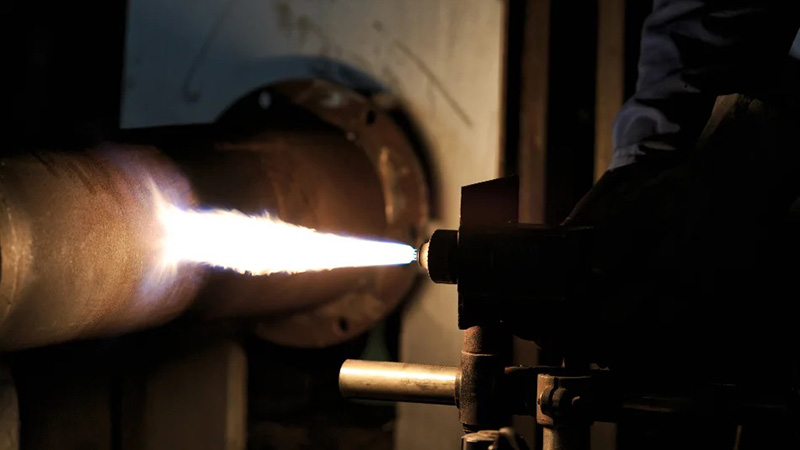
Manual Arc Welding
The stelliation can be done using a very simple method of application, manual arc welding. All this is done by manual control of the weld bead, which makes it applicable to complex surfaces.
The best time for this technique would be when one needs pinpoint control. Maintaining bead quality would require an experienced operator. Manual methods are very popularly used on small components or repairs of the milling and turning tools.
Automated Welding
Automated weld machines, which use CNC-controlled systems, apply stellite with constant accuracy. The machine takes control of the travel speed and deposition rate, which leads to reproducible weld quality.
This technique can be used in mass production where hardness and coating thickness should be consistently observed. Increase operational efficiency and minimise operator error with automated systems.
Spruzzatura termica
Thermal spraying is a method of non-fusion, which involves heating stellite powder and spraying it on a surface to construct a layer to be used for protection against abrasion. This method is usually used when the base metal should not be exposed to high heat.
Most of the time, thin coatings are often applied with thermal spraying, especially when heat-sensitive components are worked on. The resultant layer increases wear resistance without changing the structure.
Preparation Techniques for Stellite Welding
Appropriate preparation is one of the most significant parts of stellite weld processes. The base metal surface must be clear, degreased, and free of oxidation. In some cases, we may have to preheat the material to prevent cracking during welding.
Surface roughening improves bonding by providing a texture for stellite to grip onto during bonding. One example is preparing a tool used for milling, turning, or CNC work. An evenly profiled surface greatly enhances the possibility of a strong weld. Good preparation reduces weld faults and makes significant contributions to the service life of the components.
Stellite Welding Methods

Shielded Metal Arc Welding (SMAW)
It is a flexible and most-used method employed for the application of stellite. Portability and low equipment cost make it popular in the industry. In SMAW, a coated electrode is used, which melts and then deposits stellite on the surface.
It suits field repairs or smaller components, though it requires operator skill. SMAW holds good, along with reliable hard-wear-resistant coatings production on machining tools.
Gas Metal Arc Welding (GMAW/MIG)
The continuous wire feed uses GMAW or MIG welding with shielding gas to create smooth, controlled weld layers. This method is effective for large areas that require the same coating thickness to be maintained.
Fewer defects in the welding process also result from using MIG welding. It makes an excellent choice for high-quality overlays in components that will be used in CNC machining. It guarantees good fusion and a consistent deposition rate.
Laser Welding
Laser welding uses concentrated heat to melt and fuse stellite alloy to the base material. The accuracy of laser welding makes it specific to thin layers or delicate components. The heat input is small and localized, thus resulting in minimal distortion.
This method is predominantly used in industries demanding very tight tolerances, for instance, aerospace machining or highly mechanical assemblies of high performance. Laser welding can be carried out for both the repair works and the fabrication of new parts.
Deposition Welding (Cladding)
Deposition welding or cladding involves applying a thick layer of stellite to protect the substrate metal against extreme wear. This process is used when extreme resistance to wear is needed on a part. Cladding is seen regularly on turbine blades, valve seats, oilfield equipment, and heavy-load machine tools.
When these are needed, another option for these processes is to clad them with stellite-welded coatings. These are extremely durable with long service life in a hostile environment.
Welding Process Execution
Execution of stellite welding calls for a uniform and consistent state of the following. Heat input, travel speed, and selection of appropriate filler material. The process begins with preheating the base metal. If required, then apply the stellite depending on the welding method adopted. Keeping a steady arc is important in order to prevent the occurrence of defects such as porosity and cracking.
You may have to clean the surface of the joint after each bead before going on to apply another layer. If the steps are followed correctly, hard, stable coatings will result.
Post-Weld Processing
Post-weld processing guarantees the final product will perform to specified standards. This may be cooling, grinding, machining, and finishing. Since stellite is extremely hard to grind, special tools must be used to achieve the desired shape.
Controlled cooling is carried out to prevent stress build-up that may lead to cracking. To fit well in CNC systems, the final surface of parts under machining applications should have smoothness and dimensional accuracy. Post-weld processing improves durability and enhances performance.
Comparison of Welding Methods for Stellite

Tungsten Inert Gas (TIG) Welding
In terms of precision control, clean welds, and high-quality stellite overlays, TIG gets an A+ for virtues. It provides the opportunity for the best appearance of bead and fusion. Saldatura TIG is rather slow in comparison to the other methods, and it requires a more skilled operator. It is basically used when the parameters favor accuracy over speed.
Metal Inert Gas (MIG) Welding
MIG welding provides the advantages of faster processing and more uniform stellite deposition. This makes it feasible for larger areas or repetitive production work. Compared to TIG, it is much easier to learn. It is used more often in general manufacturing environments. Layers of stellite using MIG provide machining applications with reliable performance.
Plasma Transferred Arc (PTA) Welding
One of the most modern and advanced ways of applying stellite is PTA welding. Through the use of a plasma arc, it melts and deposits alloy powder with pinpoint precision. PTA creates overlays that are dense, uniform, and well-bonded.
This process is especially suited for components that experience high wear, such as valve seats, dies, and turbine parts. PTA is highly regarded in industries where consistency in tool lifecycle and performance is a must.
Laser Cladding
In laser cladding, high-energy laser beams are used to melt and fuse stellite powder onto the metal surfaces. The size of the heat-affected zone is minimal, and thus, distortion is reduced. Extremely controlled layers could be produced in laser cladding, which is widely used in parts with high accuracy requirements.
The technique is of prime importance where CNC tools are used. CNC parts are operating under extreme load and thermal conditions.
Key Welding Considerations for Stellite
In machining applications for stellite welding, the following must be considered:
Heat Input Control: Controlling heat input can prevent cracking, porosity, and distortion.
Metallurgical Compatibility: Bonding would be impaired if filler and base materials did not match.
Deposition Thickness: Layer thickness must be controlled so that uneven hardness does not develop. Thus improving the reliability of the coating.
Method Selection: Select the most appropriate welding method according to part geometry and materials requirements.
Preheating Requirements: If preheating is necessary to avoid stress, then preheating must be incorporated into the stellite welding procedure.
Controlled Cooling: Sufficient cooling time must be given to ensure structural stability.
Precision for Machining: On milling, turning, and CNC operations, where precision is important. Control of thickness is of paramount importance.
Applications of Stellite Welding
Stellite welding finds application in several industries requiring wear resistance. It is extensively used in cutting tools, oilfield devices, turbine blades, drilling components, and industrial valves. Tools subjected to continuous friction, benefiting from stellite overlays, are milling cutters or turning inserts.
Using stellite welding on worn parts instead of outright replacement is feasible. Stellite coating imparts durability and cutting stability for long-term use in CNC machining.
Conclusione
Stainless steel welding remains the greatest way to improve metal components that are vulnerable to extreme heat and wear. The component's longevity, accuracy, and long-term dependability are improved if an appropriate stellite welding procedure is used.
Get in touch with DEK right now for DFM knowledge, precision machining, or welding solutions. Allow us to assist you in selecting the appropriate application method. Let's work together to improve the longevity of your components and your tooling performance.
