
Gear Shaping: Process, Benefits, Applications
Gear shaping is used in producing varying gear tooth designs and profiles. The method offers high-dimensional accuracy and quality surface finish, complex geometry capability, and several other benefits.
In this guide, we explain the process, benefits, applications, and so on.
What is Gear Shaping?
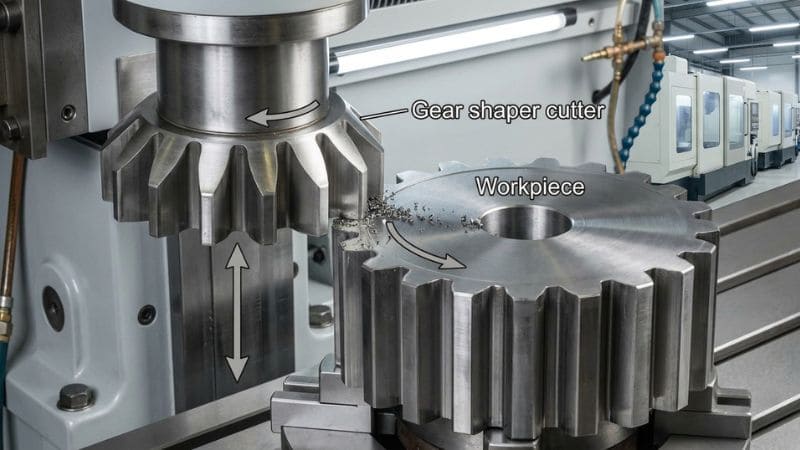
It is a specialized gear machining technique in which a reciprocating gear cutter is used to remove materials from a rotating workpiece till the desired gear shape or profile is formed. It is a vital method in producing internal gears, ring gears, and so on, used in many industries.
Key Steps for the Gear Shaping Process
Set Up and Alignment
Here, the workpiece is firmly secured on the worktable while the gear cutter is attached to the reciprocating spindle. Proper alignment is ensured to prevent uneven rotation and inaccurate tooth profiles.
Synchronization Rotation between Cutter and Workpiece
The process starts with a synchronized rotational movement between the cutter and the gear blank. While the cutter maintains a regulated up and down movement to cut, the blanks rotate at a controlled speed. This helps ensure the gear teeth are evenly generated.
Reciprocating Cutting Motion
The cutting gear tool carries out a repetitive vertical cutting stroke. For every stroke, a small amount of material is removed from the workpiece, so that the tooth spaces are generated. As this cutting motion between the workpiece and cutter continues, the tooth profile is gradually formed.
Cutting Parameters and Process Control
Accurate cutting parameters from the speed, feed rate, and stroke length are chosen based on the gear design and material. This helps eliminate tool damage while enhancing production efficiency.
Tooth Profile Formation
With continuous cutting strokes, the gear tooth depth and profile are finally formed. The overall the process produces consistent and accurate gear teeth with a smooth surface finish.
Benefits of Gear Shaping
- Large number of gears can be manufactured quickly within a short period. The machining method can create accurate gears with less supervision.
- A gear shaping machine can produce several gear types, from helical to internal and external gears, which are valuable for different industry applications.
- Compared to any other technique, it produces a quality surface finish. Its machining process eliminates material in a regulated manner.
- It also has the capacity to create complex geometry gear designs. It is usually used for internal teeth profiling and involute curves, which might be impossible with gear hobbing.
- For custom, low to medium production, it offers cost-effectiveness as there is no need for complex tooling or set up cost.
Difference Between Gear Hobbing and Gear Shaping
While both are gear manufacturing processes, the difference between gear hobbing and gear shaping lies in their tool geometry.
Here’s a simple table for quick comparison:
| Comparison Features | Gear Shaping | Gear Hobbing |
| Cutting Motion | Reciprocating cutting | Continuous Rotation |
| Tool type | Pinion or rack-shaped cutter | Hob Cutter |
| Volume di produzione | Suitable for custom, low to medium production batch | Perfect for high-volume production |
| Capacità di geometria complessa | Alto | Basso |
| Speed of Production | Moderato | Alto |
| Integration with forgings | Can be used with rolled ring forgings | Usually used after forged gear blanks. |
| Applicazioni | Internal gear, splines, ring gears | Helical gears, automotive gears. |
Challenges Associated with Gear Shaping
Tool Wear
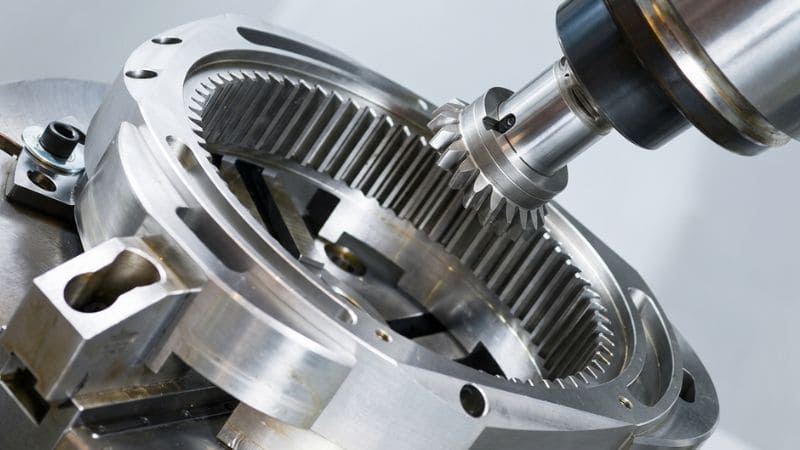
The process makes the cutting tool more prone to wear, especially when hard alloys are used. This causes constant replacement, which increases cost.
Finitura superficiale
While it is usually appreciated for its smooth finitura superficiale, achieving that can be difficult. Factors such as the rate of machining, cutting tool conditions, etc., can affect finishing quality.
Selezione del materiale
Hard alloys are usually difficult to form into shape, and some specific materials might not even be compatible with the process.
Internal Gear Shaping and Ring Gear Manufacturing
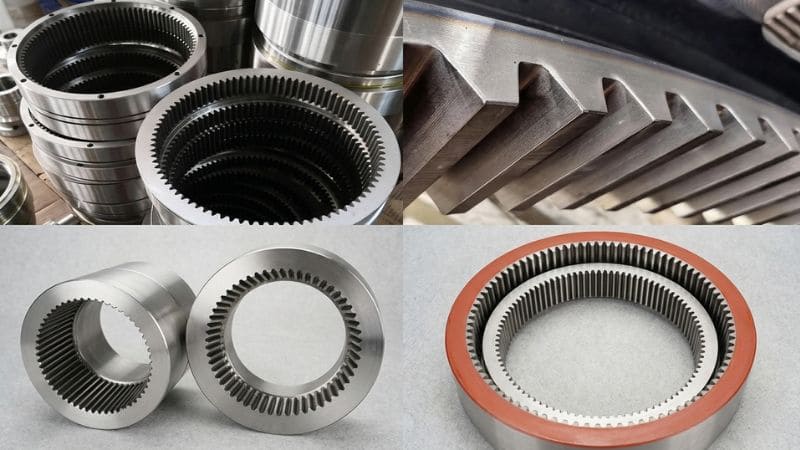
One of the most crucial applications of an internal gear shaping machine is the production of ring gears widely used in automotive transmissions and wind turbines. With the reciprocating movement of the cutting tool, the internal part of the gear can be reached, allowing for easy cutting of the gear rings.
When large ring gears are involved, gear shaping is carried out after the ring shape has been formed. While the forming process enhances the material strength, gear shaping helps create a precise internal tooth. In some situations, extra surface treatment might be applied to enhance gear performance.
When Do You Need Gear Shaping Services?
- When you require internal gear rings, splines, etc., that cannot be achieved with gear hobbing.
- You need low to medium, prototype, or custom gear production.
- Your gear application needs a specific accurate tooth profile that can only be done with a precise CNC shaper.
- Gears for critical industrial applications like aerospace, robotics, machinery, etc.
- Your project requires multiple processes, from forging to CNC machining, surface treatments, etc.
Conclusione
From internal gears to ring gears, gear shaping forms a versatile, accurate, and efficient technique for producing complex gear designs used across many industry applications.
DEK provides expert gear manufacturing solutions for clients across many industries. Whether you need custom gears or low to high volume production, we are here to serve you, so partner with us ora.
