
Why Does 5-Axis CNC Work for Complex Parts?
Working on multiple setups for an undercut that is hard to reach leads to wasted time and stacked errors. Shifting to 5-axis CNC can change the trajectory by allowing the spindle to move around the part in a single operation. It eliminates the manual flipping of the workpiece to machine a specific angle.
It is one of the easiest and most direct ways to achieve the tolerances that 3-axis machines cannot touch without the help of extra machinery.
¿Qué es el mecanizado CNC de 5 ejes?
5-axis CNC is a method that uses two extra rotational parts directly in the spindle. While the basic model is locked into a flat grid, the 5-axis CNC mill allows the workpiece and tool to move along in sync. It means that the machine can access the curves by just following the movement.
This maintains angle consistency against the block without needing a worker to stop the cycle, only to flip it. It is essentially a multi-angled process that can reach deep into undercuts and pockets in one go.
What Makes a Part Complex?
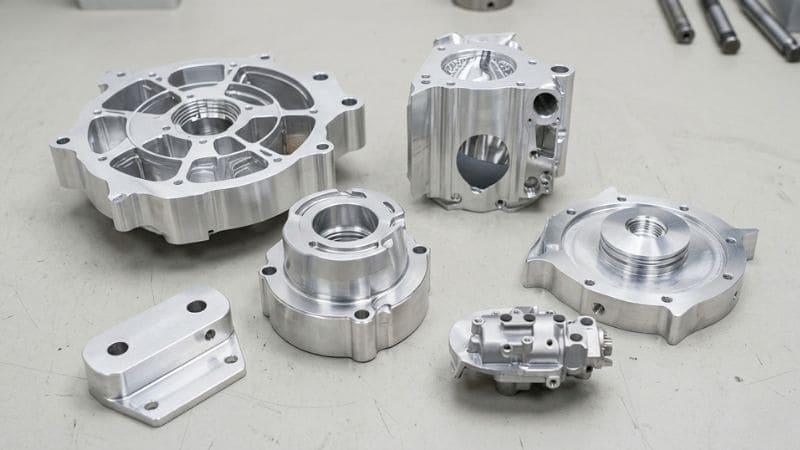
A part is called complex when the machine needs to move beyond the basic grid. These parts usually have curved surfaces, undercuts, and internal cavities that a standard tool cannot reach without the risk of damaging the workpiece.
Complexity is also defined when thin-walled areas and non-standard areas are present were manual flips would compromise alignment. If a geometry forces a multiple setup to reach all areas, then we call that complex. Because each manual intervention may introduce potential errors.
Why 5-Axis CNC Works for Complex Parts?
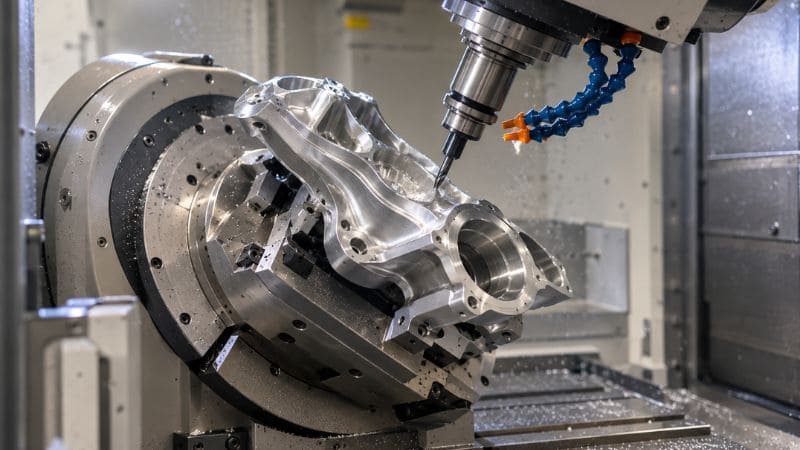
The main point why a 5-axis CNC setup works for non-standard parts is its ability to keep the cutting tool consistently perpendicular to the part's surface. In a usual standard setup, long, thin tools are needed to reach deep cavities. These tools are prone to vibration and bending.
The machine can use shorter or thicker cutters that handle higher speeds in precision by tilting the table or the spindle. This motion eliminates the stack-up error that often happens when an operator needs to stop the machine to flip the part by hand.
When the rotation happens internally, the alignment across the faces stays in place, and it turns a normal five or six-fixture job into a single continuous operation.
Features of 5-Axis CNC Machining
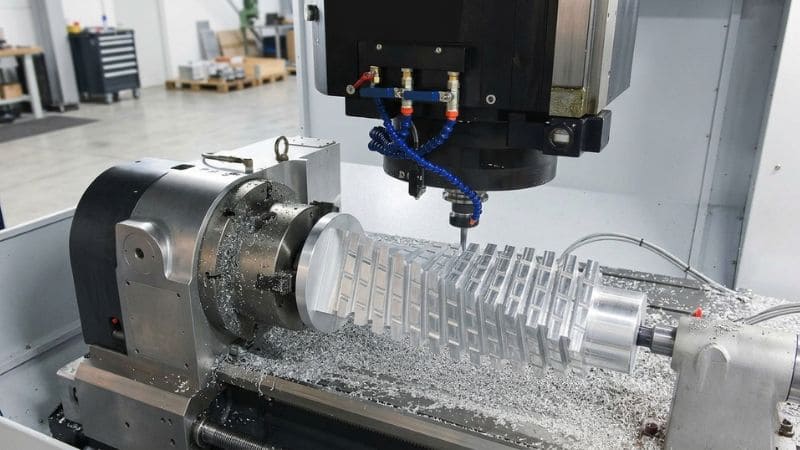
Simultaneous Axis
The table and spindle move in harmony to keep the tool perpendicular to the surface. This is important to maintain consistency in organic geometries.
Minimal Setups
Reaching multiple faces in a single setup is not only convenient, but it also eliminates errors that occur when a part is moved between machines.
Reduced Tool Deflection
By tilting the workpiece, the machine uses the sturdiest tool to do the work. Thin-walled or high-tolerance features benefit from this improved accuracy.
Surface Speed Improvement
When the tool tilts, the contact point shifts away from the center of the ball and cuts to a larger diameter. Where the surface speed is higher, dead spots are avoided where the tool rubs, and the result is a cleaner cut.
Advantages of 5-Axis CNC Machining for Complex Parts
Enhanced Accuracy
As we finish most or all of the parts in a single setup, we eliminate the stack up of tolerances. This happens when parts are moved by hand between different fixtures. When the machine keeps a coordinated single setup for every face, it ensures that slots, surfaces, and holes stay aligned and relative to one another.
Improved Setup
We benefit from the convenience of not building five different jigs to hold a part to reach various angles because one universal fixture can do it all. This reduces the time spent doing all manual labor to transition from one face to another.
Acabado superficial de calidad
We get a quality finish because when the machine maintains a constant angle, the system prevents the tool from rubbing the part. It only slices through cleanly, giving it a uniform texture even in the complex curves.
Ability to Produce Complex Geometry
Instead of multiple setups, the additional axes help us follow our organic shapes. The machine reaches non-standard features continuously in a single setup.
Disadvantages of 5-Axis CNC Machining for Complex Parts
Complicated Computing
Software capable of generating tool paths for 5 simultaneous axes is sophisticated. When dealing with defined coordinates, these programs must consider variables like whether the camera will view the piece sideways or face on at an oblique angle. Despite this complexity, the process is simple enough for a GIF-like video.
Increased Expense
A standard milling machine costs less than a CNC de 5 ejes Machine. Not just the machine but also the costs over and above it – the fixtures, the tooling, software licenses, etc., also add significantly more to the costs.
Scarce Access
Not every organization has the know-how and equipment to do this. Finding an operator who is trained to understand the system and its problems may not be easy for some. If a piece of equipment or an operator is blocked, it can create bottlenecks.
Maintenance Criteria
Machines must be calibrated constantly to control extra challenging pivot points. Since a slight discrepancy or misalignment will be exaggerated in the parts’ geometry once finished, inspections and maintenance measures are obligatory to uphold precision.
Overcoming 5-Axis CNC Machining Challenges for Complex Parts
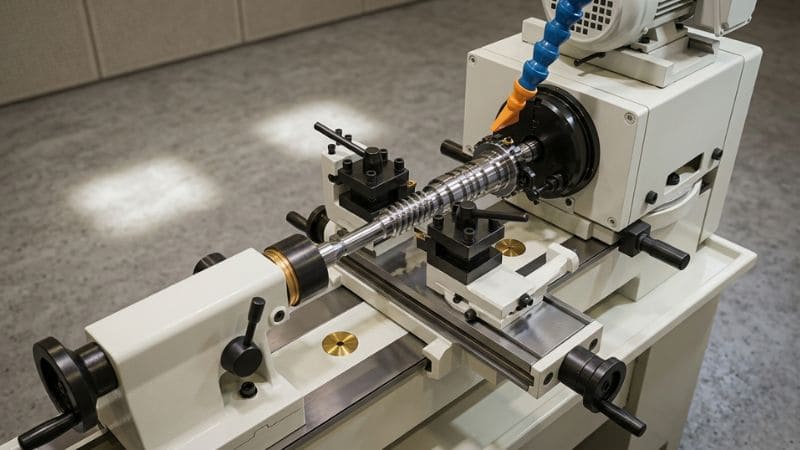
Crash Check
Although the internal preview of CAM software is reliable, it is not sufficient as a guarantee because the table and spindle are close to each other. Using the verification software gives us insight that checks the impact of potential collision and its physical limits before the tool touches the workpiece.
Adjustment of Dynamic Work
Manual centering is nearly impossible because the part is rotating on two axes. When using DWO, the controller can keep track of the part when it is tilted. This adjustment lets the device stay on track whether or not the part is on the part.
Reduced Tooling
When using a shorter tool, the 5-axis cuts faster without risk of vibration and pull-out. As a result, we opted for a shrink-fit tool holder with enhanced rigidity.
Temperature Control
Some parts of the setup get very hot due to simultaneous movements. We utilize coolants and thermal compensation sensors to maintain machine stability.
Calibration of Movement
To manage the maintenance burden, we employ wireless systems or on-machine cycles. The automated tests permit the operator to examine rotating centers in only a few minutes. The frequent updates on these parameters ensure accuracy and help prevent drifts that compromise the tolerances of piezas complejas.
Design Guidelines for 5-Axis CNC Machining
Workpiece Centralization
We keep the most intricate features close to the pivot point because errors are magnified by distance, and any tiny error at the center becomes a larger positioning error at the outer parts. When we centralize the workpiece, we minimize the leverage effect, and that ensures the tolerances are consistent and accurate.
Optimize Radii
Though it helps that the spindle can tilt, it still uses round tools. We design internal corners with a radius slightly larger than the tool. Through this, the machine keeps a constant feed rate, which prevents dwell marks on the surface.
Minimize Cavity Ratios
While we understand that it reaches deep features, we try to keep the ratio of width and depth of pockets manageable because reaching too deep will need longer tools that will lose rigidity and will eventually lead to vibration.
Tool Handle Clearance Consideration
We visualize the physical footprint to ensure that we leave enough clearance for the body and not just the cutting tip to move around the part. By considering the width of the tool holder and spindle housing early on, we avoid crashes and the need for long, less stable tools.
Applications of 5-Axis CNC Machining
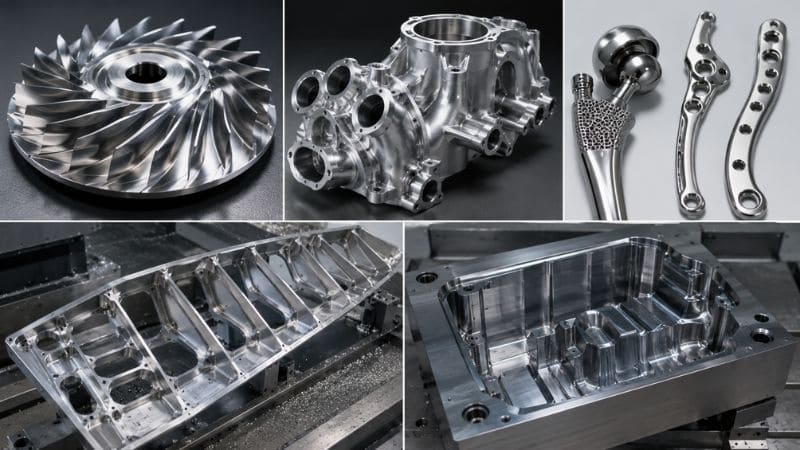
Blisk and Impellers
They feature twisted blades that are overlapped with very tight gaps. The tool must corkscrew into the material and tilt constantly to avoid gouging the adjacent blade.
Manifolds and Engine Ports
Internal tunnels with organic curves need tools to reach inside and follow non-linear paths, and may need to shift angles every few millimeters.
Implantes ortopédicos
These plates and joints have complex requirements to match human anatomy. And this machining gives a near-mirror finish without extra manual sanding.
Aerospace Ribs
The process allows these lightweight, thin-walled parts to stay perpendicular to the thin floor to prevent the material from being pushed away during the process.
Injection Mold Cores
Using this setup allows molds with deep, narrow ribs and steep drafts to get shorter cutters that can reach the bottom without the tool bending to ensure that the part will be out of the mold smoothly.
DEK: Your Reliable 5-Axis CNC Machining Service Provider
We offer an extensive range of precision CNC machining and manufacturing services based on engineering and design to create a prototype and ultimately build a product. For your toughest projects, we provide consistent accuracy and superior finish while eliminating multiple setups. Get in touch with us today for engineering support and a quote.
Conclusión
5-axis CNC machining is the most efficient way to work on intricate geometries without risking accuracy. It delivers superior surface finish and precision components by cutting down on manual steps and using more stable tools. It remains the standard in terms of producing precision components with multi-angled, complex features.
