
What is Elastic Modulus: Values, Types, Formula
When it comes to evaluating how materials handle stress, the elastic modulus is the first I consider. It is my parameter for gauging stiffness. And by looking at this value, I assess how materials react under stress and stay within their elastic range without obtaining damage.
This parameter is a non-negotiable factor to determine stability. It’s how I detect future issues like deflection and measure performance consistency before reaching physical build, helping me manage my expectations in project reliability and safety.
What is Elastic Modulus?
Elastic modulus measures a material’s elastic resistance to deformation under applied stress. I consider it a major attribute for studying a material’s rigidity within the elastic range and stiffness, where strain and stress are always present.
It can be presented in different forms based on the type of load. Different loading conditions correspond to Young’s, bulk, and shear modulus, respectively. I use them to measure how mechanical components react to stress and forces to guide me in making decisions and considering predictable dimensional change.
How are the Values of Elastic Modulus Expressed?
When I write down the numbers for elastic modulus, I’m basically recording how much pressure a material can take before it starts to give. Since we’re dealing with force over a specific area, I use pressure units. In most of my work, I stick to the metric system. Because most materials are so tough, a basic Pascal (Pa) is too tiny to be useful. Instead, I usually talk in terms of Megapascals (MPa) or Gigapascals (GPa). Using GPa just makes the huge numbers much easier to handle and remain in a report.
How is Elastic Modulus Determined?
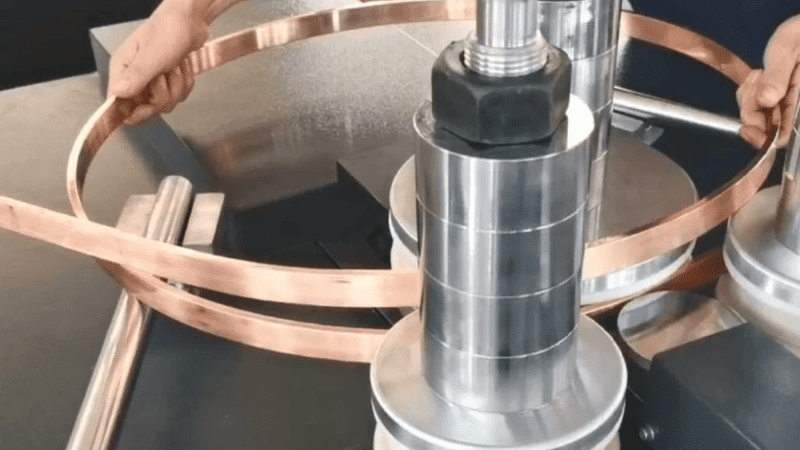
I determine elastic modulus by assessing a material’s stress-strain behavior. As the load gradually increases, it is applied to the material sample while measuring the deformation. Strain and stress remain proportional within the initial linear region. The slope of this stress-strain curve provides the elastic modulus.
Types of Elastic Modulus
Young’s Modulus (Y)
How materials respond to stretching within their longitudinal direction is characterized by Young’s modulus. I use this parameter to measure stiffness when the material is under uniaxial tensile loading. It is reported in pascals (Pa) or N/m².
𝑌 = Longitudinal Stress
Longitudinal Strain
Bulk Modulus (K)
This type is basically based on the material's reaction to being crushed from every angle. For other materials, the measure is about bending or stretching. This one is about volume. It shows how a material can keep its original size when it is being pushed from all angles with uniform stress. A dependable metric to evaluate material reaction under volumetric loading. The equation is:
𝐾 = 𝐹⋅𝑉
𝑉⋅Δ
Shear Modulus (G)
Also called rigidity modulus, shear modulus quantifies the material’s ratio of tangential estrés to angular strain in radians. I use it when I am evaluating the stiffness of a material under shear loading.
𝐺 = Shear Stress = F
Shear Strain A Pa
Elastic Modulus Values Table
| Material | Elasticity Mpsi | Elasticity GPa |
| ABS | 0.15-0.39 | 1.0-2.7 |
| Acrílico | --0.41-0.48 | 2.8 - 3.3 |
| Aluminio | 10 | 69 |
| Cobre | 16 | 110 |
| Diamante | 101.5-174.0 | 700-1200 |
| Vidrio | 10.2 | 70 |
| Magnesio | 6.5 | 45 |
| Nylon | 0.19-0.61 | 1.3-4.2 |
| Polipropileno | 0.16-0.23 | 1.1-1.6 |
| Acero | 29-30 | 200-210 |
| Titanio | 17 | 116 |
Examples of Elastic Modulus
Acero

Steel is highly stiff and resistant to elastic deformation. It has an elastic modulus of approximately 200–210 GPa. This is a reliable property when I am evaluating steel for structural applications, such as machining components, where resistance to bending and dimensional stability are highly critical.
Aluminio
Aluminio is less stiff and lighter than steel, with a modulus of about 69 GPa. It is ideal for automotive and aerospace applications where the balance of stiffness and weight is essential.
Titanio
Titanio combines corrosion resistance and high stiffness with an elastic modulus of approximately 105–116 GPa. This makes it suitable for high-performance engineering applications, medical implants, and aerospace.
Rubber / Elastomers
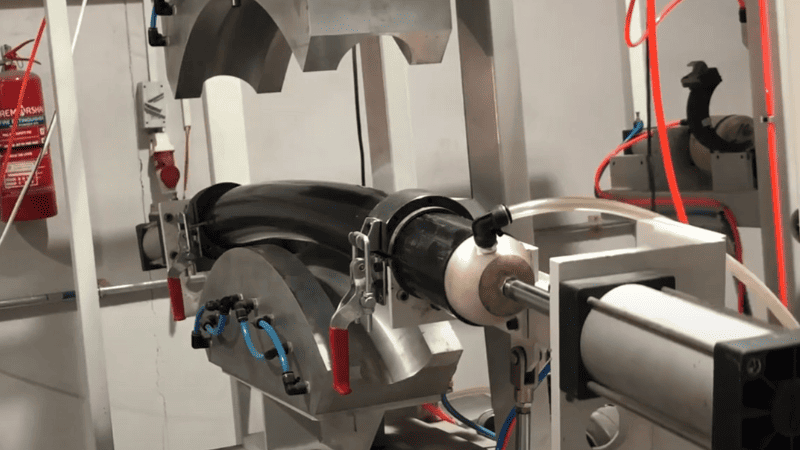
These materials are highly flexible with a very low modulus of 0.01–0.1 GPa. I use this property whenever I select components for flexible couplings, vibration damping, and applications requiring deformation without damage.
Conclusión
Elastic modulus is a core property that determines the material’s response to strain and stress. I can rely on it whenever I need to choose materials that meet performance requirements, stability, and stiffness across engineering applications. Understanding its values and types helps ensure the integrity of components in terms of efficiency and safety under load.
DEK provides expert guidance and solutions for reliable material selection and high-precision components. Contact us to source materials with the appropriate elastic modulus for your projects.
Preguntas frecuentes
What Material Has the Highest Elastic Modulus?
The material that sits at the top of the scale in terms of stiffness is Diamond. Its the stiffest material identified. Its elastic modulus is roughly 1050 to 1200 GPa. The gap between that and the other materials is generally impressive because metals, for example, generally land between 50 and 400 GPa. While most plastics are around 5 GPa. These benchmarks are a good help as a guide when choosing materials that will go under extreme stress.
What Does a Large Elastic Modulus Value Indicate?
A high value usually tells us that the material is exceptionally rigid. It’s a sign that it will not warp or stretch upon carrying heavy loads. When material is high-value, it means it can keep its original dimensions under extreme pressure. It can be used as a criterion for choosing materials for high-precision and performance. For components, tiny changes in shape can be critical.
What Does a Small Elastic Modulus Value Indicate?
Materials with a small elastic modulus show a large elastic deformation when under stress. These materials flex without getting permanent damage. Rubber is an example. It has an elastic modulus ranging approximately 0.01–0.1 GPa, depending on testing conditions and material type.
