Carburizing vs Carbonitriding: An Informative Comparison
Carburizing and carbonitriding are surface hardening treatments that are common in CNC manufacturing parts that require a hard surface and a tough core.
This article talks about carburizing vs carbonitriding in detail, including their types, process attributes, and areas of application. This will enable you to compare which method is the best for surface hardening based on efficiency and manufacturing.
O que é a cementação?
Carburizing is a thermochemical heat treatment process that increases the level of carbon on the surface of steel components. You apply this process mainly to low-carbon and alloy steels to harden their surfaces while keeping a tough, ductile core.
Carburization is achieved through the diffusion of carbon atoms into the surface of steel at enhanced temperatures. After quenching and tempering, the hardened case improves wear resistance, fatigue life, and load-bearing capacity for CNC-machined components.
Types Of Carburizing
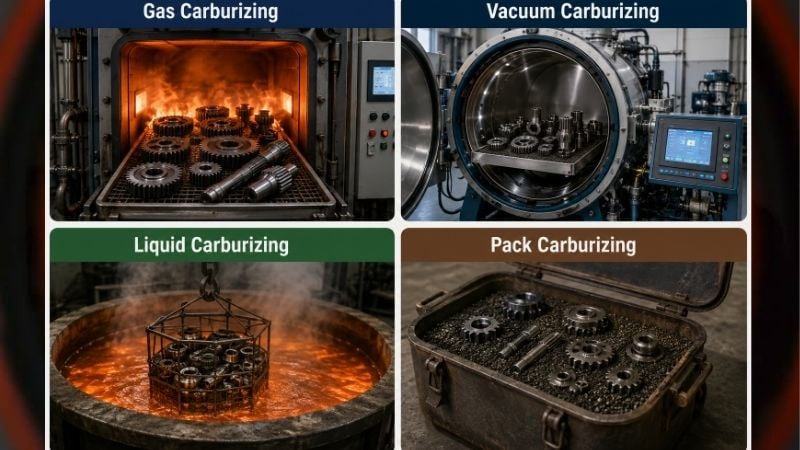
Carburação a gás
Gas carburizing is a carbon-rich gas atmosphere inside a specialized controlled furnace. The carbon potential, temperature, and time are all finely adjusted to create a specific case depth. It produces very homogeneous hardness in repeatability, therefore ideal for high production at CNC manufacturing. It is mostly used in gears, shafts, and most parts produced by CNC milling and turning.
Carburação sob vácuo
Vacuum carburizing is done in a low-pressure furnace using hydrocarbon gases. It has very fine control over carbon diffusion and much less oxidation and distortion. Thus, it is the ideal case for precision CNC parts that require very carefully cleaned surfaces and narrow tolerances. Vacuum carburizing also allows for deeper case depths, better stability, and snapping back to dimensions.
Carburização líquida
In liquid carburization, steel parts dipped in molten salt baths containing carbon-bearing compounds undergo carburization. It is a relatively fast phenomenon, and the cycle time is short.
Unfortunately, environmental and safety concerns limit its usage in modern times. Small components whose tolerances and case depth and hardness would be moderate applications would typically find liquid carburizing.
Pack Carburizing
Pack carburizing places the steel parts in a sealed container filled with carbon-rich material. This container needs to be heated for long periods for carbon to diffuse throughout the parts. This method provides poor control over case depth and consistency. Most people used pack carburizing for low-volume production or simple parts manufactured by basic machining methods.
Carburizing Process Attributes
Carburação is done at high temperatures with controlled atmospheres to facilitate carbon diffusion. You decide on temperature, time, and carbon penetration to control accurate case depth and superficial hardness.
The process develops a tough core and a hard outer surface under the tough, thick case, enhancing fatigue resistance. Carburizing is very useful for CNC milling and turning applications. The components are subject to extreme contact stresses and cyclic loadings during service.
Applications Of Carburizing
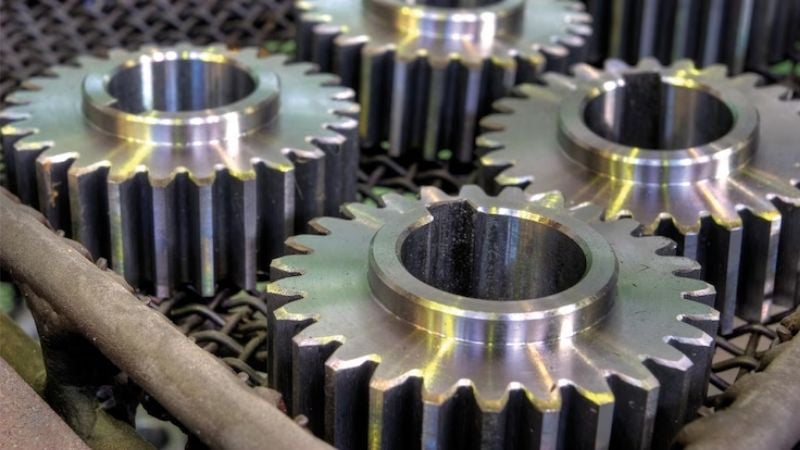
Engrenagens
You use gears that have a hard surface because they absorb huge contact stress. The surface becomes very resistant to wear. Simultaneously, the strong core can take in shock loads in CNC production, which works continuously without resting.
Eixos
Carburizing strengthens the shafts for rotating systems. It is supposed to be excellent in fatigue resistance and surface durability. It supports the accuracy of turning operations on CNC under cyclic loading and torque conditions.
Buchas
Bushings that have undergone carburizing enjoy a much longer life in sliding operations. Here, you have surface deformation restricted to a negligible level, with repetitive CNC-based manufacturing.
Sprockets
It is needed to harden the teeth of the sprockets to resist wear. Carburization aids in surface strength. It retains the core's strength during program life cycles, where it is engaged in mechanical activities time and again.
Cam Components
Many cam surface areas generate high friction and contact stress. When carburized, the cam's surface will be very wear-resistant. It is able to overcome the problem of wear, permanently, in CNC-produced engines and automation components.
What is Carbonitriding?
This is a thermochemical heat treatment on the surface to introduce both carbon and nitrogen to steel. It is more easily applied to low-carbon steels. A thermochemical treatment is required for a hard surface in relation to the case depth. It offers better wear resistance, keeping precision parts from changing dimensions.
Carbonitretação is run at lower temperatures compared to carburizing. Nitrogen enhances hardenability and strength on the surface. So it is helpful when small CNC-machined parts are milled and turned. The design tolerances are strictly adhered to, providing stability in surface finish performance.
Carbonitriding Process Attributes
Carbonitriding is carried out in a protected gaseous atmosphere rich in carbon and ammonia. Gas and gas mixture compositions are adjusted differently to allow restricted gas flow and carburize with nitrogen.
A mild, hard surface layer with very slight distortion compensates for the entrance of impurities into the surface. The cycle is shorter than that of carburizing, which is good for increased production efficiency.
The case is shallow, but the way the surface is hardened makes it extremely resistant to wear. Carbonitriding is applicable in high-end CNC machining where accuracy is the word.
Applications Of Carbonitriding
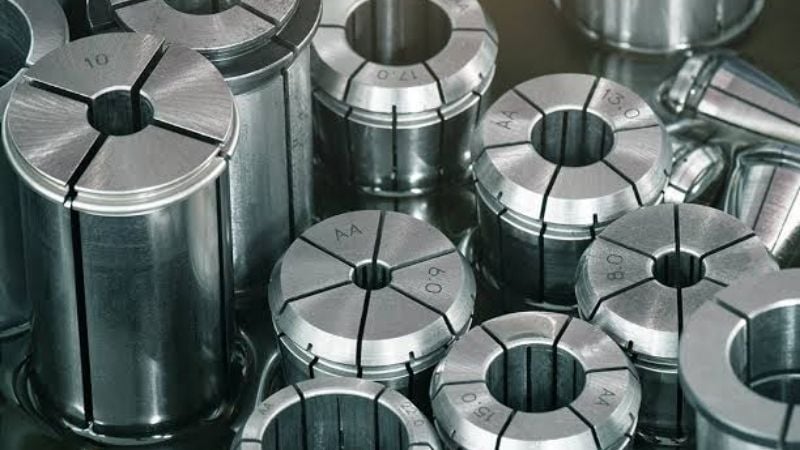
Fixadores
The hardening and wear resistance of screws and bolts are improved with carbonitriding. You achieve high surface hardness with minimum distortion, thereby supporting precision CNC-manufactured fastening elements.
Alfinetes
Shallow hardened layers can be applied with carbonitriding on pins. This improves wear resistance while also maintaining dimensional accuracy for CNC-machined assemblies.
Small Gears
The carbonitrided gears operate well under moderate loads. The hard surface reduces wear and supports compact transmission and motion components manufactured in-screen CNC technology.
Buchas
Carbonitriding helps improve the life of bushings concerning lighter applications as it leads to reduced friction and stable performance in precision CNC machining systems.
Sheet Metal Components
Carbonitriding suits thin parts that need surface hardness. You minimize distortion while improving wear resistance for CNC-processed formed components.
Benefits and Limitations: Carburizing vs Carbonitriding
Carburizing provides deep case depth, good fatigue resistance, breakdown strength, and general high strength. It can be used for all highly stressed and shock-exposed component applications. The combination of a tough core and a hardened surface makes it very suitable for CNC-milled and -turned components such as gears and shafts.
CNC machining components have high surface hardness, shorter cycle time, and minimal distortion using carbonitriding. Dimensional controls are also better utilizing this method because of the shallow case depth. It limits the number of applications in heavy-duty parts. It works well with small, precision CNC components that require wear resistance instead of impact strength.
What to Include in Heat Treating Specifications For Carburizing and Carbonitriding
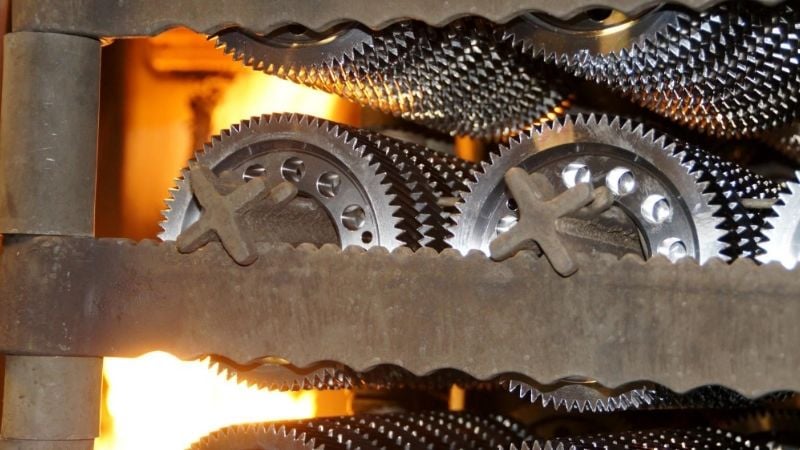
You should then specify the material grade, prior processing condition, and, finally, required case depth specifications. Surface hardness, core hardness, and acceptable hardness range must be clearly defined. You also need to include dimensional tolerances and areas requiring masking.
We are cautioning the specification of clear ones so that the results shall match on a consistent basis after the CNC machining action takes place. Accurate data on heat treatment is of major help in avoiding rework during milling or turning of the various parts.
It provides well-defined requirements for an efficient production system while maintaining functional performance and dimensional accuracy.
Thermochemical Treatments for Surface Hardening
Here’s a simple table showing the common types of steels and the treatments applicable to them:
| Material Grade | Carburação | Carbonitretação |
| A36 Steel | ✔ | ✔ |
| Aço 1018 | ✔ | ✔ |
| 1026 Steel | ✔ | ✔ |
| 3312 Steel | ✔ | ✔ |
| 5120 Steel | ✔ | ✔ |
| 8620 Steel | ✔ | ✖ |
| 9310 Steel | ✔ | ✖ |
Conclusão
Carburizing and carbonitriding are necessary surface hardening treatments that improve wear resistance, fatigue strength, and durability. You should carefully select between them based on case depth, load conditions, and application specifications to confirm optimal performance for CNC-machined components.
DEK specializes in high-quality manufacturing and provides detailed DFM feedback to help you optimize milling, turning, and CNC production processes. By leveraging DEK’s expertise, you can achieve precise, efficient, and reliable manufacturing outcomes while ensuring your parts meet the highest performance standards. Contactar-nos anytime.