
Glass CNC Machining: Processes, Tools, and Tips
Glass components used in optics and electronics are required to have precise geometry and flawless edges. With glass CNC machining, internal stress and edge chipping are minimized while under controlled shaping.
In this blog, let’s discuss glass CNC machining further by knowing the processes, materials, and some tips that you can use.
What is Glass CNC Machining?
In CNC machining, glass is shaped using computer-controlled equipment designed to handle brittle materials without causing cracks. This is especially necessary for glass parts that require strict surface and dimensional specifications that manual processes cannot maintain. Features, such as holes, contours, and flat surfaces, can be produced with repeatable accuracy for better integration and electronic and optical reliability.
How Does Glass CNC Machining Work?
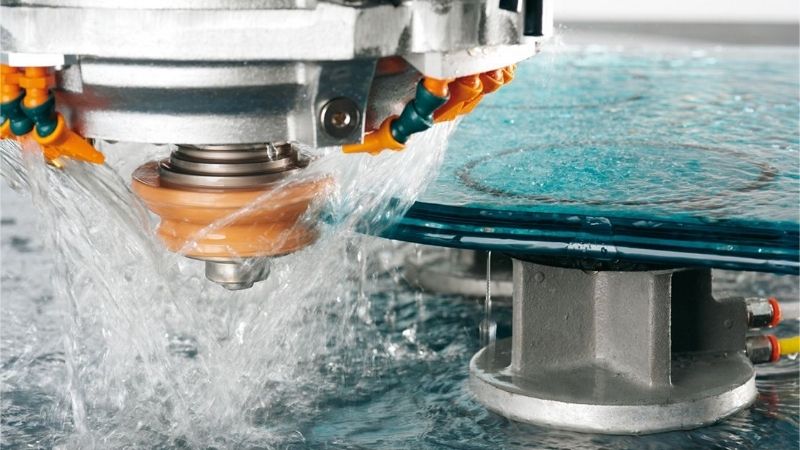
Diamond-coated tools follow through programmed toolpaths to gradually remove materials without causing fractures during glass CNC machining. Instead of aggressive cutting, the process relies on grinding. To stabilize the temperature and reduce stress, coolant is continuously applied. The fragile structure of the glass is protected while ensuring accuracy through motion control.
Main Stages of the Glass CNC Machining Process
Дизайн: This is when geometry is modeled and planned with attention to internal stress, edge strength, and tool accessibility, with careful consideration of the risk of fractures during the process.
Set Up: Vacuum fixtures or cushioned clamping systems are reinforced on glass blanks to stabilize them without introducing pressure that can cause cracking when tools contact.
Machining: Following programmed tool paths, grinding heads, or diamond-coated tools incrementally remove materials at a controlled feed rate and coolant flow to balance heat and prevent damage.
Polishing and Finishing: Fine grinding and polishing processes are used to refine functional surfaces and edges to achieve the required surface quality, reduce micro-cracks, and improve transparency.
Inspection and Quality Control: Using precision measurement tools, surface condition, edge integrity, and dimensional accuracy are verified to confirm that the finished component meets the performance and tolerance demands.
Techniques Used in Glass CNC Machining
Фрезерование
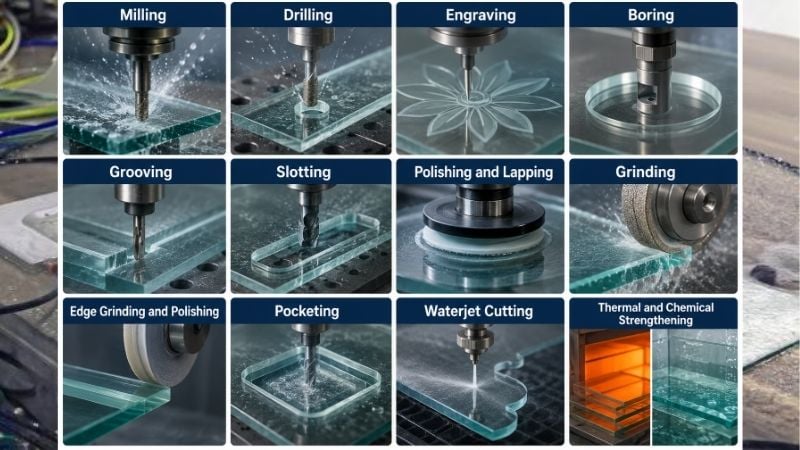
Glass milling removes material gradually using diamond-coated end mills through controlled grinding rather than an aggressive cutting technique. Carefully balanced spindle speeds and feed rates avoid edge chipping while coolants stabilize temperature to reduce cracking.
Бурение
Specialized drill bits with diamond abrasives and low-pressure, steady advancements are used in making holes in glass. Peck бурение clears debris and relieves stress, and with proper support beneath the material, it helps prevent breakouts.
Гравировка
By tracing programmed paths with fine diamond tools, engraving shows detailed patterns or shallow markings. Uniform depth must be maintained while preventing cracks.
Скука
Improved surface finish is achieved with boring, and it also refines holes to tighter diameter tolerances. Stability is achieved through incremental material removal while concentricity is maintained with minimal radial force and spindle alignment.
Нанесение канавок
Controlled channels into glass for assembly interfaces, guides, and seals are cut using grooving. To minimize stress concentration, tool engagement must remain shallow while the uniform motion prevents fracture.
Slotting
Using gradual lateral passes, elongated openings are produced by slotting. Glass gets to maintain structural integrity through consistent support beneath. To reduce thermal buildup that could introduce cracking, coolant helps, especially along narrow sections.
Polishing and Lapping
Progressively fine abrasives are used in polishing and lapping smooth machined surfaces. Surface irregularities and micro-cracks are removed by this finishing step. It enhances both mechanical and optical performance by reducing surface roughness and improving clarity.
Шлифование
Using diamond wheels, grinding shapes and contours with controlled pressure. Compared to conventional cutting, this method reduces stress by using appropriate wheels to determine the removal rate and finish quality.
Edge Grinding and Polishing
Refining edges is required to eliminate sharpness and reduce cracks, which is why grinding and polishing not only strengthen but also improve handling safety. A better fit is also achieved in assembled components when a consistent edge profile is used.
Pocketing
It creates recessed areas by removing materials within a defined boundary. This helps in preventing internal stress buildup through gradual depth increments. To avoid a directional change that could compromise stability, toolpath planning is required.
Гидроабразивная резка
A mix of a high-pressure stream with abrasive particles is used in waterjet cutting to separate glass without thermal distortion. The method is ideal for thicker sections and complex outlines.
Thermal and Chemical Strengthening
Strengthening treatments increase impact resistance which is why glass may undergo that process after machining. Chemical processes alter ion distribution on the outer surface, while tempering introduces compressive surface stress that both improve durability.
Glass Types Suitable for CNC Machining
Боросиликатное стекло
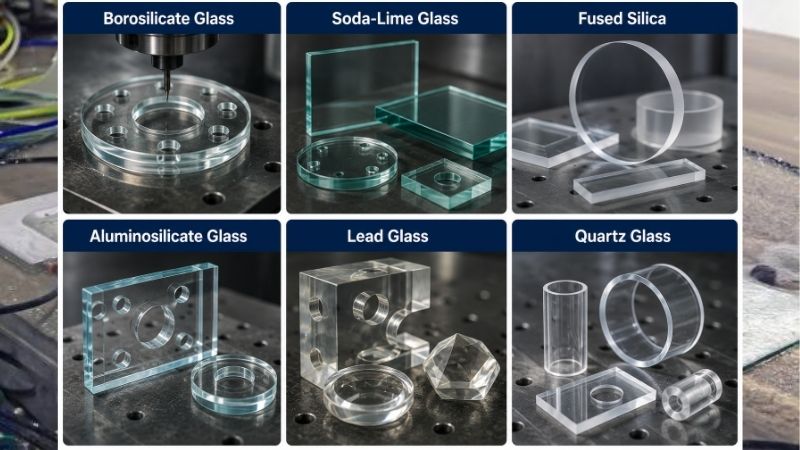
This type of glass resists thermal expansion and temperature changes and performs well in CNC machining. It is stable enough to lower the chance of cracking during drilling or grinding. A common choice for precision components, laboratory equipments and optical mounts.
Стакан с содовой
One of the widely used because of its availability and low cost. This type can be drilled, edge-finished, and shaped with diamond tooling and proper speeds. It is often applied in elements where thermal resistance is not required, like covers and panels.
Fused Silica
A highly reliable material for precision machining because of its very low thermal expansion and purity. Even when materials are exposed to rapid changes and heat, it maintains its structural integrity. This is often used in high-accuracy glass parts and optical components.
Алюмосиликатное стекло
With better resistance to mechanical stress, it also provides higher strength compared to standard ones. It can be used in complex machining because of its durability. Often used in critical parts that need to resist impact and maintain structural reliability.
Свинцовое стекло
The composition of lead glass machines improves material workability and reduces stress during grinding. It results in better surface finishes and finer detailing. Typically used in radiation-shielding components, optical systems, and decorative parts.
Quartz Glass
Its extreme stability with a resistance to chemicals makes this type valued in CNC machining. It maintains optical clarity and structural consistency while enabling precise shaping. This is often used in optical instruments and semiconductor manufacturing.
Advantages of Glass CNC Machining
- Precision and Repeatability
- Speed and Efficiency
- Настройка
- Automation and Safety
- Excellent Surface Finish
Limitations of Glass CNC Machining
- Operator Expertise
- Cost of Tooling Equipment
- Brittleness Risk
Applications of Glass CNC Machining
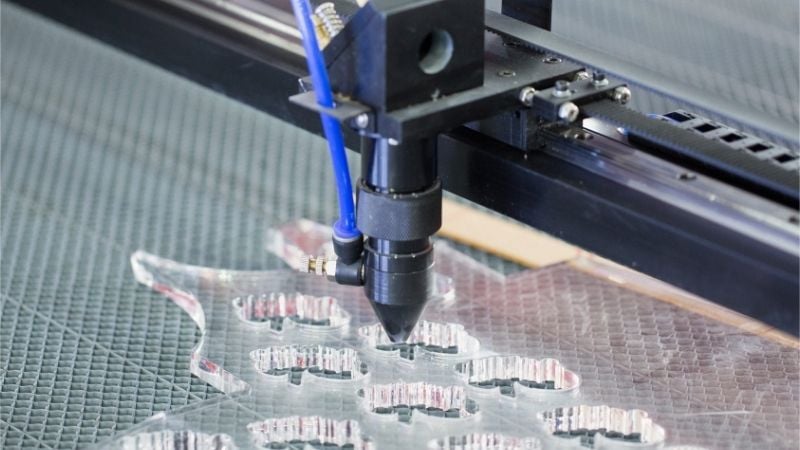
Various industries rely on CNC glass machining to create precise components, such as electronic substrates, optical elements, and medical components were dimensional control and clarity are all important. This method is also reliable for scientific equipment, industrial inspection panels, consumer device covers, automotive displays, and aerospace sensors that require durability, reliable performance, and accurate shaping.
Selecting the Right Glass CNC Machine Provider
Selecting the right glass CNC machining provider can be based on experience with fragile materials, tooling capability, and process control. Reliability can be tested in consistent finishes, strict inspection standards, and maintaining tight tolerances.
At DEK, we deliver dependable results and professional support for your glass components to meet your required performance and technical requirements. Contact our experts today.
Заключение
Glass CNC machining shapes fragile materials into precise parts while keeping up with the required stability and clarity. Its approach to control of cutting conditions, tooling, and finishing maintains accuracy. The method enables the production of glass components that are dependable, consistent in dimensions, and reliable in performance.
