

While the manufacturing industry continues to experience a talent shortage, many shops have already strategized ways to keep their key employees and talents within. One of the ways used by many is providing internal stock plans to teams.
But do these incentives and benefits actually keep employees motivated and help retain them? Rather than following that strategy, a few shops have learnt to build an ownership culture.
Ownership culture creates an atmosphere where an employee can take initiative, actively contribute, prevent firefighting, collaborate to ensure quality delivery, and so on.
This kind of environment focuses on rewarding performance and expertise rather than years of experience. Moreso, it helps teams understand how their decisions and actions directly influence the company’s performance.
Shops like this have learnt to build a stable workflow, clear processes and standards, and access to required resources that make quality performance and talent retention feasible.
In this blog, we explore this current trend and why ownership mindset beats internal stock plans.
What Internal Stock or Profit-Sharing Really Means

By allocating equity to key professionals and ensuring consistent profit sharing based on the company’s revenue, many shops seek to retain their talents and ensure they stay committed to success.
Equity allocated to key employees in private companies
In many private manufacturing companies, equity is usually allocated to key technical personnel and senior employees as a way of granting them a stake within the company.
This helps them feel a sense of ownership as it boosts their commitment towards the company’s success and growth.
Dividends or profit percentages shared when the company performs well
Similarly, when the company performs well and experiences an increase in revenue, employees are allocated their percentage of the profit.
This is to say that as the company makes more profit, employees get their share of it, which directly boosts their quest to perform better.
Often used to retain senior staff or reward long-term contribution
Equity allocation and profit sharing are thus used by many shops to retain senior staff and reward them for long-term commitment.
In today’s era, when hiring skilled professionals could be daunting, many shops use these plans to keep their senior talent within and to provide long-term financial reward.
The Benefits of Internal Stock Plans

There’s no doubt that employee stock plans offer some benefits. From enhancing employees' loyalty to retaining them and creating a sense of commitment to the company’s etc.
Increases loyalty through long-term financial alignment
With the internal stock plans, employees understand that the company’s growth and success directly translates to their own long-term financial gain. This inherently boosts their commitment and loyalty towards the company, pushing them to perform better in their roles.
Helps retain experienced managers and technical leaders
I’ve seen many senior managers and technical leaders stay within a company for more than 30 years. Many companies like that offer great equity systems and profit-sharing schemes that keep these professionals motivated at the job throughout the years.
Beyond receiving salaries, stock plans help them feel like a partner rather than an employee.
Encourages stability and reduces turnover
Stock plans also help create stability within the company. With these financial gains, employees are less likely to switch jobs, and with that, they can learn the complex workflow of the shop, retain and apply it throughout many years.
When employees leave companies, on the other hand, recruitment and onboarding begin again, and new staff are trained all over again. This creates instability in the whole system.
Creates a sense of participation in company growth
When employees have a stake in the company, it gives them a sense of participation. Every little success and milestone gives them pride as they are part of something big.
This, in turn, serves as motivation and enhances job satisfaction and improves their commitment.
Why Internal Stock Alone Doesn’t Create True Ownership

Despite the benefits internal stock offers, it doesn’t create true ownership, as many other factors influence the manufacturing systems and employee motivation.
Profit depends on factors most employees cannot influence
Profits generated within the company are influenced by a lot of factors that are beyond employees' control.
From an increase in raw material cost to shipping fees, market conditions, quoting, and lots more, employees' great performance might not directly translate to huge annual profit. When they realize this, commitment drops.
Dividends feel too far from daily tasks and daily frustrations
I’ve seen many employees who aren’t really motivated by the internal stock plan method. They feel the daily tasks, KPIs set, and the daily frustrations they face in their jobs outweigh the performance of stocks and profit shared.
Complex rules make stock feel abstract, not motivational
Internal stock often comes with legal rules and conditions from vesting periods to tax, etc., which many employees don’t understand.
As such, they perceive the stock as being abstract or unrealistic financial gain. With that, the stock plan loses its effectiveness, and employee commitment drops.
Equity doesn’t fix unclear processes, bad communication, or chaos
When the workflow and system within a shop aren’t clear, Equity cannot fix the problem. Infact employees get more frustrated rather than being motivated.
Ineffective communication and constant firefighting only decrease productivity and employee morale, which affects revenue generation.
People want autonomy and clarity, not just a financial promise
Many talented employees value autonomy and clarity rather than financial gain. They want to contribute actively in their roles, make decisions, and perform well in their job without constant supervision and rules.
They want to understand the company’s process and help achieve success. While financial gain is good, talented employees feel a greater sense of ownership from autonomy and clarity.
What an Ownership Mindset Looks Like in Manufacturing
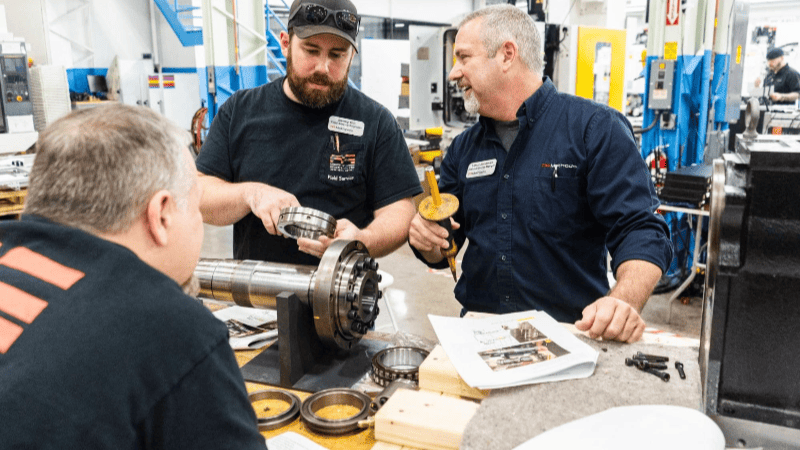
From ensuring quality delivery, preventing problems, to focusing on long-term results and understanding how every decision affects the company, ownership mindset within a shop goes beyond internal stocks.
Taking personal responsibility for quality and delivery
An ownership mindset takes beyond completing tasks or following orders. It revolves around ensuring quality components are delivered every time.
When everyone takes responsibility and accountability for their actions, they maintain the highest quality standards, ensure customer satisfaction, and protect the company’s reputation. And as Henry Ford said, “Quality means doing it right when no one is looking.”
Preventing problems instead of passing them downstream
Moreso, an employee with an ownership mindset works towards preventing issues rather than passing them downstream.
When there’s a little problem with surface finishing or a machining tool, this set of employees takes proactive steps rather than hoping teams from another shift fix it. And this eliminates recurring risk and firefighting.
Understanding cost, scrap, risk, and customer impact
This set of employees understands how their actions and decisions affect cost, scrap, risk, and customer satisfaction.
They know that every step they take within the company generally affects the overall company’s performance, and as such, they work towards performing their best and meeting the company’s goal.
Thinking beyond tasks — focusing on results and long-term value
And rather than just complete the assigned task, they focus on the result and long-term value. They ask what we aim to achieve with this project.
And what are the ideal steps to achieve success with it? Do we need a specific fixture, CNC machining tools, or an inspection process? Overall, they focus on long-term success rather than only the task given.
Behaving as if “my decision affects the entire company”
And this is the real deal when it comes to employees with an ownership mindset. They understand that every decision they take impacts the entire company and, as such, handle the shop the way they will do with theirs.
From ensuring safety practices to maintaining machines and fixing little issues before they escalate, they take active steps to ensuring company’s success.
Where Internal Stock Plans Fail in Daily Operations

From machining to engineering, programming, and QC, a balanced system and workflow, and clear standards are required for optimal performance rather than equity or dividends.
Operators and technicians influenced more by workflow than profit
From experience working with expert operators and technicians, I understand many values a smooth workflow. They enjoy it when a system has machines working effectively with quality standards met every time and delivery done on time.
Consistent issues with equipment, fixtures, or finishing frustrate these experts, and even profits don’t motivate them when these problems keep occurring.
Profit-sharing does not solve production bottlenecks
And when production issues keep arising due to inefficiencies, profit sharing doesn’t solve the problem.
Allocating equity to teams won’t solve problems with machines or quality control. As such, the real production issues must be corrected so employees can perform at their best.
Machinists cannot change pricing, customers, or supply chain issues
Machinists, on the other hand, cannot directly dictate a company's pricing, customers, and supply chain issues. A customer might delay payment, suppliers might increase raw material price or deliver below standards.
All of these are beyond the control of the machinist. And even when they put their best into their role, they can’t totally control the amount of profit generated, and this influences the profit shared.
Dividends don’t motivate when the system itself is broken
And even when a huge dividend is paid, employees lose motivation when systems are unclear, workflow isn’t balanced, and resources are limited, or machines are faulty.
All of these hinder productivity as employees begin to see that even when they put in effort, results aren’t showing. And this affects their morale.
Compensation cannot compensate for unclear standards
For efficient quality delivery in a company, there must be clear standards and expectations. Employees must understand every part requirement and the protocols to maintain.
Without clear standards, achieving success and gaining customer satisfaction becomes almost impossible, and no amount of compensation can fix that.
What I’ve Observed in Teams With True Ownership Thinking

When I see teams with true ownership thinking, the difference is always clear from those motivated by internal stocks.
Faster problem escalation and fewer repeated errors
Teams with an ownership mindset don’t hide errors or mistakes. They escalate it quickly so solutions can be provided before it turns into bigger issues.
With this, they make fewer repeated errors as they learn from previous mistakes. And the result is a consistent quality delivery with less or no firefighting.
Stronger cross-role collaboration (machining–QC–engineering)
With an ownership mindset, teams learn to work together to achieve the company's goal. When everyone focuses on delivering quality, they collaborate with others to achieve that.
From machining to programming and quality control, effective communication is maintained so that quality parts can be produced.
More pride in craftsmanship and consistency
When employees begin to think like owners, they take pride in craftsmanship and consistency. They are naturally geared to deliver exceptional results and maintain such consistency.
This isn’t about rules, but the inner motivation of delivering quality and being a team within a successful shop.
This inherently shows in the quality of components produced. And as Soichiro Honda noted, “Real happiness lies in the completion of work using your own brain and skills.”
Higher retention than teams motivated purely by incentives
And more importantly, teams with an ownership mindset stay longer in their role than those motivated by incentives only.
When an employee feels like a part of a working and balanced system where everyone's ideas matter and effort is appreciated, they stay longer.
At DEK, teams with ownership mindset outperform equity-based teams in consistency, initiative, and customer satisfaction
From experience working with different employees at DEK, I’ve seen the clear difference between those motivated by incentives and those with an ownership mindset.
Teams with ownership thinking take initiative, prevent firefighting, ensure quality control and work towards customer satisfaction and generally deliver great results than those motivated by incentives.
How Leaders Can Build an Ownership Culture

Building an ownership culture takes an intentional effort by the leader. By sharing necessary business context, rewarding initiative and improvement, building a stable system, and avoiding chaos, etc., manufacturing leaders can develop an ownership mindset among teams.
Share business context (not secrets—clarity)
When employees understand a certain business context, they are geared to improve performance.
By helping them understand customers’ expectations, why a part requirement is important, why certain lead times must be met, and so on, they tend to understand the business context well and work towards achieving great results.
Define decision boundaries so employees can act, not wait
By defining certain decisions employees can make and creating boundaries where needed, teams begin to develop an ownership culture.
They don’t have to wait for guidelines every time to complete their job, as they understand what’s expected and the level of their authority. When the team needs permission or instructions before taking any step, an ownership mindset can’t be built.
Reward initiative, improvement, and accountability
By acknowledging and rewarding teams that take initiative and improve processes, we can encourage an ownership mindset.
When an individual takes a step to prevent a big issue or firefighting or finds a strategy to reduce machining time, and they are acknowledged publicly, this encourages others to behave the same way.
Build processes that reduce chaos and empower judgment
Encouraging an ownership mindset in a chaotic environment won’t bring any positive results. People flourish and deliver well in a structured and balanced system rather than one with constant chaos.
With a stable workflow, reliable machines, and resources, teams can confidently use their own judgement.
Promote based on contribution, not years of service
When manufacturing leaders begin to appreciate and promote employees based on their contribution, expertise, problem-solving skills, etc., rather than years of service, then it becomes easier to build an ownership culture.
When people see that their contribution matters rather than the number of years spent, then they begin to deliver better results.
My Perspective
Over the years, working with different teams and visiting different shops across the world, one thing has become clear.
While internal stock plans have a way of boosting employees’ morale, they actually don’t help them build an ownership mindset. And when ownership thinking isn’t built, it’s difficult for staff to put their best at work.
An employee with an ownership mindset strives towards quality, prevents firefighting, and strategizes on improving processes, values clarity and stable workflow rather than chaos.
They take pride in their craftsmanship, focus on results rather than just completing tasks and are happy to be part of a team that works.
This set of employees understands that their actions and decisions affect the company’s performance, and this helps them strive for success.
And without a stable workflow and clear processes and standards, improving talent performance and retaining them become non feasible even when a huge dividend is allocated.
Frustration and chaos become an everyday routine, which burns out most talent. And this is a major difference between shops that build ownership culture and those that focus on internal stock allocation.
